Pages

Showing posts with label holidays. Show all posts

Sunday, October 16, 2011

Counting My Blessings

My granddaughter Tamar singing new year greetings learned in kindergarten

The month of Tishrei brings a whirlwind of celebration, soul searching, stock taking, resolution and renewal. I was privileged this year to be a guest at my children's homes this year for Rosh Hashana and Succot. It must be a mother's greatest pleasure to see her children raising their own children and passing on traditions. On Rosh Hashana this year I heard my eldest son lead the morning prayers. I heard him say words of Torah to his students both at home and at the Yeshiva where he teaches. The first night of Rosh Hashana at my other son's house included besides the usual symbols of the holiday a quiz aimed at the younger set which had us all laughing and applauding. Having seven holiday meals in three days gave us an opportunity to do justice to all three families of our married children in Mitzpe Ramon. 

Succot brought another first opportunity. This time we went to the brand new settlement of Naveh in the western Negev. This is where my other son moved from the temporary settlement at Yated. So not only was this the first time we visited him in his new home, it was also the first time he built his own sukka. After the holiday we were joined by my son from Mitzpe Ramon making it  real family celebration. 
This post can best be summed up by the traditional blessing thanking god for having kept us alive and sustaining us and bringing us to this season. 
ברוך...שהחיינו וקיימנו לזמן הזה!


Tuesday, September 27, 2011

Preparing for Tishrei

 I always feel empowered when I am surrounded crowds of Jews in Israel. How much more exciting can it get than two thousand Jewish women converging on the site where the woman who taught us all what prayer is all about. The  T'filat Hannah at Shilo featuring the Rabbanit Yemima Mizrahi was an excellent prelude to Rosh Hashana which is after all about reaffirming God as our king, doing tshuva (repentance, but the English lacks flavor) for our sins, recalling our past and praying for our future. The chapter of Hannah's prayer is read as the haftara on Rosh Hashana.
Rabbanit Yemima is an interesting phenomenon and this was my first direct encounter with her stand-up sermonizing. She is knowledgeable and well versed in sources and in between her jokes and impersonations she has deep and serious messages. She keeps the crowd interested and the time passes quickly. It was a moving experience and I was overcome by emotion by the time she had finished speaking and we had come to a moment of silent prayer. She challenged us to take the opportunity to single out three things on which to focus our prayers; one personal, one for another individual close to us and the third for Jewish people. It was an exercise in soul searching which I am still mulling over. Batya tells me that Rabbanit Yemima also gives talks in English but I wasn't able to find an example of this.


There are many fine programs here in Israel and everyone has something special going on leading up to the high holidays. My personal favorite shiur is a podcast from Yeshivat Har Etzion's KMTT (ki mitzion tezei torah) series given in April 2007 by Dr. Yael Ziegler which you can listen to here. Rabbanit Ziegler addresses what we associate with the Yom Kippur ceremony done in the Temple by the Cohen Gadol (high priest) of sending one goat away and sacrificing the second goat on the altar. In less than half an hour she teaches us how this ceremony, while associated with Yom Kippur is really a paradigm for the different kinds of tshuva required by different situations. She brings ideas from Rabbi Soloveitchik, Rav Kook, Rav Bruer and Talmudic sources tying it all to our patriarch Abraham's experiences with his two sons. On the first day of Rosh Hashana we read about how he must distance Yishmael from his household and on the second day we read of his taking Yitzhak to be bound before God as a sacrifice on Mt. Moriah. This parallels the two goats, one driven away and the other brought before God. [The word קרבן translated as sacrifice in English actually reflects the Hebrew root krv which means closeness.] These two actions can be related two ways of viewing tshuva. One is by distancing the bad deeds and inclinations from ourselves and the other by harnessing the energies and using them to become closer to God and to the person we want to be. Each way is appropriate in certain situations and probably totally out of place in others.


You should really listen to Rabbanit Ziegler because she says it much better than I do. You can find more of Dr. Ziegler at Matan an institute for women's Torah studies in Jerusalem, where she teaches.

And if you're still with me here's something to help me wish you all a happy and sweet new year!


Monday, September 26, 2011

Preparing for the New Year!

Like my sisters and brothers around the world I am busy getting ready for the upcoming Rosh Hashana holiday. This year the New Year begins on Wednesday night and on Thursday and Friday we gather in our synagogues to hear the shofar blown. Then without any further ado we go right into Shabbat. All this heralds a marathon of eats and on Rosh Hashana we go all out with symbolic foods signifying all the good things we wish for ourselves and our community in the coming year. For a thoughtful discussion of these symbolic foods you should read this post by The Rebbitzin's Husband . You might also be interested in this post of Leora's about the symbolic foods
While we're on the subject of cooking for this amazing holiday let me remind you to take a look at the Tishrei edition of the Kosher Cooking Carnival at Cooking Outside the Box a delightful blog with lots of interesting ideas while the Elul edition of the Kosher Cooking Carnival is up over at Me-ander . 
Batya Medad
Rabbanit Yemima intoduced by Tzofia Dorot
 And speaking of Batya, my favorite Shilo resident, I had a lovely experience at Tel Shilo  where both she and I attended the Tfilat Hannah and heard the inspirational Rabbanit Yemima Mizrahi. I hope to write separately about this moving experience.  She was followed by concert given by Leah Shabbat and Tal Bril.
The event was organized by Ancient Shilo which runs tours of the archaeological dig at the site where the Tabernacle stood. Besides Batya I also ran into a very good looking reservist who was called up especially to guard us and the approximately two thousand other women and young girls who attended this event. This particular reservist also worked as a guide at this site when he lived in the nearby settlement Eli. He also happens to be my son. How thoughtful of the army. 
Reservist Shayke Tzohar 

Tuesday, August 09, 2011

A Meaningful Fast

It would have been nicer if we didn't have to fast on Tisha B'Av this year. But since we did not merit the rebuilding of the temple in Jerusalem we fasted and mourned the destruction of the first two temples.
This year I had some very meaningful experiences which I'd like to share.
On the night of Tisha B'Av we gather in our synagogues for the ma'ariv (evening) prayer and read the scroll of Eicha (Lamentations). This year I participated in a special reading done by women. It was followed by a program which included reading the Kinot (poems of mourning) with a view to better understanding them. The program moved on to learning other literature relevant to the destruction interspersed with our singing solemn songs a capella. It was a very moving experience.
In the morning I went to my regular synagogue where we had the usual morning service followed by reading the Kinot with historic and contextual explanations by our own Rabbi Aryeh Frimer. That was followed by a lesson about the legend recounted in the Talmud of Kamtza and Bar Kamtza given by another member of our congregation.
Marking Tisha B'Av is not easy for us today. On the simplest level we are talking about events which took place thousands of years ago. It's hard to keep up the sense of loss over so many years. Of course, it wasn't just a building that was destroyed, it was the entire way of life of the Jewish people in their land and their religious observance. It was the start of the exile which has still not come to an end. Over the years Tisha B'Av has become the day for mourning many other serious tragedies which have befallen the Jews all the way from the Crusades through the Holocaust. So while it is not difficult to relate to mourning historically it is a challenge to make it personal.
Experiences like the ones I had this year make the day much more meaningful. And here lies another paradox. Jewish mourning rules do not permit learning Torah because we love it and it brings us comfort. For this reason on Tisha B'Av we are permitted to study only 'bad' things (i.e. about the destruction) or nothing at all. So if I have a sense of satisfaction because I have come closer to understanding the tragedy that is Tisha B'Av is that good or bad?
My hope and prayer is that next year I won't have to deal with these questions.

Tuesday, April 05, 2011

Learning to Ask ~ Passover Preparation

ראש חודש ניסן תשע"א
Rosh Chodesh Nissan 5771

Frume Sarah's World is hosting Haveil Havalim #311- The Warp and Woof Edition here. Ima on (and off) the Bima has the latest Kosher Cooking Carnival here
 Like everyone else, I am getting ready for Pesach. Of course I'm cleaning, planning menus and shopping planning to shop. There is Pesach in the air here. The day after Purim, all the stores are advertising cleaning materials and housewares. Pesach has taken over the airwaves and the advertising.
Our shiurim (classes) are all about Pesach, getting ready for the holiday spiritually and practically. This Shabbat we announced the coming month of Nissan and read the Maftir emphasizing the importance this month, calling it THE month. And what a month it is!
 No holiday beats Passover for nostalgia. I believe that some of my earliest memories are of the seder night. I remember sitting at the table in my grandparents house and my grandfather getting up to go to the kitchen to wash his hands and my mother calling me over to take a matza from the table. She said "we"ll hide this in the other room while grandpa is washing" and we went into the small closed porch where there was no light on because my baby brother was asleep there (just shows how long ago that was) and she said to me "we'll wrap it in this diaper and put it here near the baby so they won't see it". I remember feeling vaguely confused as to why my grandfather was making such a fuss about getting up from the table to go to the kitchen and why we needed to put the matza near the baby.
 Then first grade rolls around and I am attending an all day Jewish school where we learn Jewish subjects and Hebrew reading in the morning and the three R's in English in the afternoon. We have been given a Hagada and we must learn the Ma Nishtana (4 Questions) by heart in time for the seder. We spend  what seemed like weeks repeating the Hebrew words alternately with the Yiddish translation.
Tate, ikh vil dir fregn de fir kashes
Ma nishtana halayla hazeh mikol haleylot.
Farvos iz di nakht fun peysekh andersh fun ale nekht fun a gants yor?
The Yiddish, it was explained to us, was so that our grandparents would understand (and be impressed with us). My memory of getting up that year and singing this is of a great feeling of accomplishment at having done it and lots of smiles and encouragement from the assembled mixed with a total blank as to understanding what I was saying. I'm glad my grandparents understood what I was singing, because I certainly didn't. Oh well. What I did understand was what the English teacher taught us and that was this song:

At the time, I didn't know it was associated with slavery in America. I really did think it was about Moses and the Jews.Over the years I have developed an understanding of the significance of feeling that I too was led out of Egypt and have tried to pass it on to the next generation. Now, dozens of seders later I am getting ready once again. Only now it's my turn to prompt grandchildren to 'steal' from their grandfather and ask questions. What a privilege!

Sunday, March 20, 2011

Happy Purim!

Happy Purim!
Photos taken on Friday morning of children on their way to pre-Purim celebrations in the kindergartens and elementary schools. 


OK, not really a costume!
More Straight Out Of the Camera 

Friday, March 18, 2011

Wild flowers, spring and hopes for better times

Wild flowers
Yesterday we fasted the 'Fast of Esther' commemorating the fast Esther and the Jews kept before she risked her life to go to the king and get Haman's decree revoked. Tonight we will be lighting Shabbat candles and tomorrow we will read the 'Zachor' describing the attack by Amalek on the weakest of the travelling Israelites during the travels in the Sinai after leaving Egypt. The tradition is that Haman, the villain of the Purim story, was descended from Amalek and so we read this portion which includes a commandment to remember (zachor זכור means remember) the attack by Amalek and wipe out Amalek.  This public reading is done on the Shabbat before Purim and both men and women are required to hear the reading. Then on Saturday night we will be reading the Purim story and celebrating yet another deliverance. 
In the Megilat Esther (the Purim story is read from a scroll named after Esther) there is not one mention of the name of God. How could that be? How could there have been deliverance without God's intervention. There have been many many interpretations given through years but the one that rings especially true this year is that God is not mentioned in order to show us that the evil decree is an example of hester panim (when God figuratively hides his face) as the word hester is alluded to in the name of the queen Esther. The deliverance came not by supernatural miracle - as in the parting of the Red Sea - but through Esther's brave deed along with the moral support of Mordechai all the Jewish people. This teaches us to look at all of life as a miracle through which God manifests his presence in the world. Sometimes his plans for the world are in tune with our expectations and we consider that state 'natural' and other times it is harder for us to accept events because we fail to see their meaning. This week has been one of those weeks when it is difficult for us to understand God's presence in our world. 

This week began with the funeral of the Fogel family of Itamar.Over 20,000 people accompanied them to their graves. It was difficult even to watch the broadcast and I can only imagine what it must have felt like to be there in person. All the eulogies were emotional and raw reflecting the shock of the brutality. The former Chief Rabbi of Israel Rav Yisrael Meir Lau, who was the youngest survivor of the Buchenwald concentration camp (7 years old at the liberation) said
"it appeared as though the cycle of terror closed 66 years ago, when the blood of infants was spilled like water, when a million an a half children were trampled at the hands of beastly people.  "Sixty-six years have passed. We announced a State, we achieved independence. We established the magnificent Israel Defense Forces. And still, this cycle of terror and the river of blood flows, and we stand here helplessly." 
In addition he addressed remarks to twelve year old Tamar Fogel saying that she will now take on a role of 'little mother' to her surviving brothers (8 and 2 years old) who will have to be the 'kaddish' for their parents' memory in the years to come.  I noticed many well-meaning folks, mostly women, who felt that this thought was out of place. Let the little girl remain a child. Don't burden her with this responsibility. Would that we could! But Rav Lau knows different. His life is a testimony to to just how resilient a child can be. But no matter how much everyone wants to help, and will help, those children will ultimately share with each other an emotional tie that is like no other. .
(If you haven't read his autobiography אל תשלח ידך בנער in Hebrew you will apparently be able to read it soon in English and everyone should read it!) 
Cyclamen
And in another one of those weird 'only in Israel' ironies an IDF army medic saved a new born Arab baby girl in the Neve Zuf settlement where the Fogel's parents are sitting shiva

It's been a sad week for us in Israel and around the world. The earthquake in Japan and the bad to worse condition of the nuclear power plants have yet to be fully understood. When we empathize we usually call upon a similar emotion or reaction in our memory to help us feel the pain of others. But the horror that is happening in Japan, I have no parallel experience to call upon. I can only imagine. Japan is the only country to have experienced nuclear fall-out and that was in wartime. I always imagine that what Japanese must feel towards nuclear destruction is similar to the horror which we feel about the Holocaust. I am trying to imagine an earthquake killing thousands followed by a Holocaust and no end in sight.
Anemones


And so it goes. Life is made of cycles, grief and danger, joy and deliverance. Through all of it certain things stay the same. The winter is drawing to a close and next week is spring solstice. There are wild flowers blooming in Rehovot and as the seasons change the flowers bring hope of nature's renewal.
And now we can only pray that God bring order back into our lives and give us strength to go forward. 
עושה שלום במרומיו 
He who keeps the peace in his world 
הוא יעשה שלום עלינו
He will bring peace (and order) upon all of us 
ועל כל ישראל
And on all Israel 
ונאמר אמן
And we will say amen!

Thursday, December 02, 2010

Happy Chanuka DeLuxe - L'mehadrin min hamehadrin!

See Mrs. S for the latest in Internet Chanukah lore. 

If you are looking for ways to make eight days with the kids educational and interesting you can get some really inspiring educational ideas and learn a little something yourself at this special Hanuka site  called Women and Wonder: A Family Hanukka Website. There are stories, projects and music to keep you busy and interested. A nice touch is that it available in English (which I linked to) and Hebrew and Russian. For me, this is good since I have enjoyed reading the English and now can share it with our kids and grandchildren in Hebrew next week without having to make any extra effort!

Haveil Havalim is up at the Home Shuling  which is  nice Jewish parenting blog and Miriyummy is getting ready to post Kosher Cooking Carnival (or should be so be prepared). 
.

Tuesday, November 02, 2010

Rosh Chodesh Kislev
Women's Prayers at Tel Shiloh
Sunday, November 7 · 9:30am - 10:30am
There will also be a Dvar Torah

תפילת נשים
ראש חודש כסלו
תל שילה
יום א' ל' חשון
7-11 9:30
יהיה דבר תורה, בע"ה

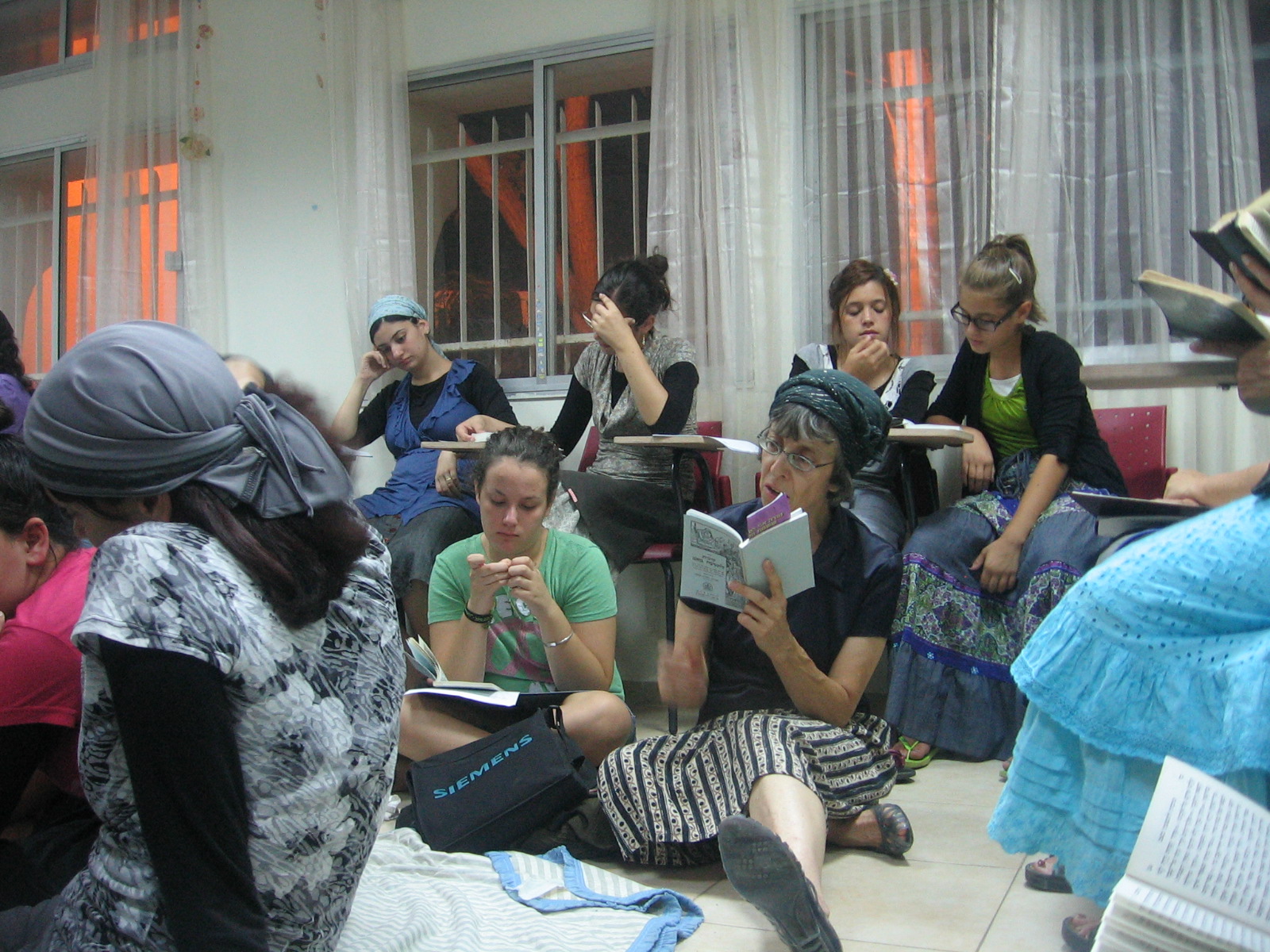
Rosh Chodesh is a special day for women. Our sages tell us that at the time of the sin of the golden calf the women did not actively participate. 
ונתן להם הקב"ה שכרן בעולם הזה - שהן משמרות ראשי חודשים יותר מן האנשים 
ונתן להן שכר לעולם הבא - שהן עתידות להתחדש כמו ראשי חודשים  פרקי דרבי אליעזר
God gave them their reward in this world - they mark Rosh Chodesh more than the men.
And he gave them their reward in the world to come - they will renew themselves as does the new moon.
Pirkei  D'rabbe Eliezer

Join us on Sunday at Tel Shiloh where we will be singing our Hallel together and sharing divrei Torah 

Thursday, October 07, 2010

Women, Rabbis, History - 5771 is going to be an interesting year!

Reform Rabbi Frume Sarah has done a lovely job of Havail Havalim #285 called Back to the Beginning.
And yes, this has been a week of so many beginnings that I had to pick a few to begin this week and few will have to wait till next week. Oh well, happy 'after the chagim' to everyone!

My 5771 beginnings
Monday evening we returned to our regular women's gemara class at my synagogue led by our amazing teacher Nahum who demystifies (did I just invent that word?) the world of the Talmud and helps us as we slowly but hopefully steadily improve our Aramaic and learn to analyze the gemara's logic.We are learning Brachot. (This dvar Torah is from the siyyum of the first chapter.)

Tuesday morning I went to the first class of the year at the new women's beit midrash (literally: study house) appropriately named Bina Yetaira (literally: greater wisdom*). The class is given by Rabbanit Malka Piotrkovsky is entitled "The wisdom of the sages - selected studies of educational philosophical halachic issues taken from oral Torah sources". The first topic was women and Rosh Chodesh (the new month). Rosh Chodesh is considered a special day for women and we followed the discussion about how the women marked this day and why. We read from the Talmud, midrash and halachic sources. Her teaching style is very interactive and there was never a dull moment.  There were about 50 women there from many different cultural backgrounds and some of them shared the special Rosh Chodesh customs of their mothers and grandmothers. There are many women in Rehovot who are interested in expanding their knowledge of Jewish sources and it is gratifying to see that the demand is being taken seriously. Kudos to the Amit women's organization and the Rehovot municipality  for sponsoring this program.  It was an amazing learning experience and I look forward to participating in this class.

Tuesday evening (in between I did go to work) I went to see the first play in this year's series subscription that I share with my friend Yael (6 plays that are fixed and 1 which you get to chose out of 4 possibilities). I like the subscription idea for several reasons. One is that it's cheaper than buying individual tickets. The second is that it exposes you to plays you might not choose yourself either because they are by new or obscure writers or because you just are not familiar with them and besides I would never be organized enough to find out about and buy tickets to seven plays in one year. The play was Arthur Miller's A View From The Bridge. I will write more about that soon.
Wednesday morning found me at orientation for the transcription and digitization of Sir Moses Montifiore's censuses of Jewish communities in the land of Israel and Egypt and Sidon. I already participated in this project for the censuses of 1855 and 1849 and we are now doing 1866 and 1875. I find it exciting to deal with these real life lists of people who returned to Zion and see where they came from and what they were doing. On Sunday night I missed a celebration of the launch of the online census searchable database in which we volunteers were given certificates honoring our part in the project. I was given my certificate this morning. And here is my name in the credits on the site (my 15 minutes of fame?).

*The Torah says (Braishis 2:22) that G-d created Eve from the body of Adam. The term used is "vayiven", from the verb bonoh, "and He built". The rabbis had an oral tradition that this verb "vayiven" has an additional level of interpretation, from the root "binah". "Binah yeseirah" was given to women more so than to men. Women mature intellectually at an earlier age than men; therefore girls should become bat mitzvah at age twelve, while boys only attain their intellectual maturity at age thirteen (Talmud Niddah 45b) (from here).

Wednesday, September 29, 2010

The Joy of Torah!

 Soon we will be sitting down in our succa for the final meal there this year. We will be having our traditional meal of chicken soup with kreplach (sometimes known as Jewish won tons). Towards evening I'll light my candles and then we"ll begin a marathon of a holiday. In the evening there will be services which include seven rounds of dancing with the Torah (hakafot - literally 'going arounds'). We eat dinner much later than usual. In the morning we have even more dancing hakafot, all the men are called up to bless the Torah, the children get a special blessing under a huge talit, we finish the reading cycle of the Torah portions and immediately begin the new cycle, we say hallel, yizkor (memorial prayers for the dead) and tefilat geshem (prayer for rain in Israel). Outside of Israel all this is divided into two days. But here it all comes together.
I wrote about how my community manages all this  in my Simchat Tora Review. Last year I shared a dvar Torah appropriate for Simchat Torah at  Looking forward to Simchat Torah!
Hadassah at In The Pink asks if Simchat Torah is just for men. I certainly don't think so!. 

Sunday, September 19, 2010

Sukkot ~ Old & New!

Now that Yom Kippur has past we turn our thoughts and efforts to Succot. We came home from synagogue tonight and after some refreshment you could hear the sound of hammers joyfully getting the sukka ready. The fact is one used to hear more hammers but nowadays the succa is just as likely to be of the 'instant' version made of cloth walls strung on an aluminum frame. Just before Yom Kippur I read about an interesting competition taking place in New York City. It's called Sukka City 2010 and it attracted 600 entries from 43 countries. The architects and designers had "to re-imagine this ancient phenomenon, develop new methods of material practice and parametric design, and propose radical possibilities for traditional design constraints in a contemporary urban site." The official website of the contest includes an informative page with the biblical roots of the succa and a summary of the rules (known as halachot in these parts) that need to be followed in order to properly build the succa. It's an interesting mix and if you look at this slide show you will see that there are some broad interpretations of those rules. 
The judges have already chosen 12 of the 600 entries and they will be on view in Union Square Park in New York City today September 19 and tomorrow September 20. You can vote for the winner at New York Magazine even if you don't live in New York. The winner stays on view in the park for the duration of the holiday. You can also buy one of the succot and the proceeds will be donated to help New York's homeless. That's a nice touch. 

Another one of those 'Only in Israel' days!

It's not that I think that we need more ways to make our holidays relevant.Yom Kippur is pretty relevant all by itself. In Israel from just before sundown on the afternoon before Yom Kippur until the stars come out the next night all traffic stops. There are no cars on the roads and no planes land or take off from our airports. The radio and television go off the air and everything but the synagogues closes down. There is no law of the state that requires this. It is just what happens in the Jewish State.The result: according to an item in Haaretz
"Air pollution in Jerusalem and the Dan region was 100 times less on Yom Kippur than on ordinary days, when cars are on the roads, air pollution monitors from the Environmental Protection Ministry found.
"According to the figures released by the ministry Sunday, levels of nitrogen oxide in the Dan region over Yom Kippur were two to 12 parts per billion - but when the holiday was over, the figure rose to 205 parts per billion. In Jerusalem, the numbers declined from 250 parts per billion in the afternoon before Yom Kippur to between two and 12 parts per billion during the holiday."
That's such great news that even Dov Hanin who heads up the Hadash (ultra-left and vociferously anti-religious Arab-Jewish party) to tout Yom Kippur as an environmental experiment and brag about how at a European environmental conference the European delegates reported success in attempts to institute experimental 'no car' days of up to 25% compliance, while the Israeli delegate could point to almost 100% compliance. (full article here in Hebrew) It's nice to see even he can find the positive value in Yom Kippur!

Thursday, September 16, 2010

WWW = Wonderful Women on the Web

rutimizrachi  of Ki Yachol Nuchal! has put together a Carnival of jbloggers who have banded together and formed Kehila the brainchild of Eric at The Israel Situation. She has put together a lovely collection of blog posts decorated by lovely pictures of food  fruits and flowers. 
Batya at me-ander has posted the 58th (tfu, tfu, tfu) Kosher Cooking Carnival  which she calls "Carnival for the Hungry" because she wrote it on Tzom Gedalya. It should be appropriate for Saturday night when we finish our fast of Yom Kippur. 
And speaking of Yom Kippur Adventures in Mamaland found this here a sign of the times that shouldn't need any explanation. 

Here's wishing everyone a G'mar Chatima Tova and a meaningful fast
גמר חתימה טובה

Tuesday, September 14, 2010

Women and Prayers

On Rosh Hashana one of the readings we have is of the very invention of prayer as a Jewish form. This is the story of the childless Hannah who sits outside the Tabernacle at Shiloh (the temporary forerunner of the Temple later built on Mt. Moriah in Jerusalem) and prays to G-d to let her have a child of her own. She vows to return him to the Tabernacle at age three to serve G-d, if only she could bear a child. Hannah not only invented prayer but the sages learn the rules of prayer from this first chapter of the book of Samuel. 
Without the development of prayer as a means of coming before G-d and establishing a communicative relationship God, Judaism would have been at a loss to replace the sacrifices in the Temple as a unifying expression of devotion to G-d  after the destruction of the Temple. While the Torah gives us very specific instructions for bringing sacrifices in the Temple it was left to Hannah and after her the sages who applied her model to define and refine the act of praying. 
This evening I attended a presentation by three very talented women using the model of mothers' prayers to inspire us to a more meaningful experience during these days between Rosh Hashana and Yom Kippur. Rabbanit Pnina Neuwirth gave an inspiring talk about the prayers we encounter in the bible including Hannah and Rachel's prayers for fertility and the various views of what constitutes prayer and why G-d needs to hear our prayers. The amazing singer Hagit Kfir accompanied by her daughter Hila on the guitar sang which emphasized and illustrated (can you say that about a song?) the points that Neuwirth made.
The clip below is of Hagit Kfir singing with another woman Adi Arad singing Ana Bekoach. The melody is by Ovadia Hamama 


The words in transliteration and English translation can be found here. The prayer is recited just before the L'cha Dodi prayer which welcomes the Sabbath on Friday night and on the high holidays. It's theme is beseeching G-d to hear our prayers and help us. The prayer is very old and written with a great deal of mystical allusion.

Here is a short clip showing Hagit Kfir and Rabbanit Neuwirth in a similar presentation.


Gmar Chatima Tova  גמר חתימה טובה 
May we all be inscribed in the book of life. 

Wednesday, April 21, 2010

Making Deserts Bloom and Other Miracles

Singing Hatikvah with my children when they were young filled me with awe. Could this be me? Monday night I stood and sang the national anthem with my grandchildren!!! What an honor and privilege! Baruch Hashem!
For some statistics on Israel's population today see: 
here.


David and I drove down to Mitzpe Ramon to celebrate Independence Day with our children and grandchildren there. The super-rainy winter left the desert greener than usual and we took full advantage of the phenomenon. Here's what the roadside looked like. 

We arrived in Mitzpe Ramon just in time for the ceremony marking the transition from Memorial Day (Yom Hazikaron - see below) to Yom Haatzmaut (Independence Day). It was nicely done beginning with words by the Rav Tzvi Kostiner of Midbara Kaeden Yeshiva. Tehilim were read and there was a presentation about bereaved families and fallen soldiers. After the flag was raised to full mast we had presentations by the local music ensemble and the kindergarten children danced for us with flags and balloons. Then we sang Hatikva and went inside for a festive evening prayer. This year there were two separate venues for the ma'ariv, one at the Yeshiva and one in the community synagogue in the local elementary school. I am overwhelmed by the realization that I live in a time and place where we are thanking Hashem for a miracle that we are witnessing. I find it hard to put into words. 
Then, as with so many other Jewish holidays, went home to show our appreciation for the miracles that G-d sends us by eating
In the morning, after the shaharit (morning) service which included Hallel and a leisurely breakfast (in commemoration of  Sundays in golus/New York :)) we organized ourselves for a trip to the local swimmin' hole. Because of the generous rainfall this year (a blessing from Hashem, part of which we witnessed on the very rainy Shabbat HaGadol just before Pesach) there is a rather large natural pool of water right down in the Ramon Crater about 10 minutes drive (can also be done by hike or bike) from Mitzpe Ramon. It was a bright sunny day and my son brought a beach umbrella and mat so we were able to spend over two hours at this amazing attraction (unshielded from the sun you really want to leave after about 10 minutes). So sunscreened and with lots of good spirits we enjoyed our 'beach' outing. We even had ices! 
Meanwhile, back at the ranch, busy family members were setting up the traditional Bar-B-Q without which no Yom Haatzmaut is complete. We were joined by many friends and neighbors of my children including families who had once lived in Mitzpe and returned to visit. Everyone was in a good mood although I don't know where the kids get all their energy. 


David and I still had one more stop we wanted to make on our celebratory itinerary. We wanted to see the new site of the Atzmona (the pre-army Torah learning and training program for religious boys which was uprooted from Gush Katif) community where one of our sons teaches and plans to live. So off to the western Negev we went. 
 
And then we went to have coffee before the drive home and say hello to the rest of our grandchildren in the temporary housing of this community in Yated. 


Happy, tired and feeling really blessed we returned home to Rehovot. 
What a week!


Sunday, December 27, 2009

Chanuka in the USA


As readers who follow this blog know we spent Chanukah in the US. Below is a picutre of our son-in-law lighting candles at David's parents home in Philadelphia. It was a very happy visit and we had a nice chacne to visit with most of our family in New Jersey and New York as well.

December in the US is an interesting time to visit. When I lived there I found it a difficult time of year.
Some of my earlies memories are of  learning the difference between us and them. Most of the time it didn't matter. But those few weeks, after the inclusive all-American holiday of  Thanksgiving came those weeks of Santas, evergreens and in the very Christian neighborhood where I grew up, nativity scenes. It wasn't a hostile atmosphere and of course I never had to associate it with hiding from marauding Cossaks, as my grandparents did. I never heard an anti-Semitic remark from any of our neighbors. We had warm relations with most of our neighbors. Chanukah did come just at the right time for us to get presents and not have to feel jealous. I only wished I could really be mainstream, in sync with the culture around me. That's why I feel so good here in Israel. Now, I can enjoy a trip to Manhattan to delight in the lovely (if commercial) holiday sights.


Snowy Street in New Jersey


The Deck & The Woods


The Aftermath


Fifth Avenue


Rockefeller Center


Across Central Park at 81st Street


The View from Starbucks
And for  balance, here is the Lubavitchly billed "World's Largest Menorah at 59th St. & Fifth Avenue!


Thursday, December 10, 2009

Holy Land, Holy Lights

In bloggersphere terms it has been a long time since the last post. These past few weeks have seen more discussions about our government's negotiations for the release of Gilad Shalit and plenty of heated debate and action and counter-action regarding the Netanyahu government's hasty, ill-conceived, anti-Zionist and cruel 'settlement freeze'. I have imagined several posts but all of them turn into very negative rants and are neither constructive nor enlightening rather than write, for now, I talk back to the radio and computer screen and spare the rest of you my unabridged rage


David and I are taking off in a few hours for two weeks of visiting with our families in the US. Our trip and all the accompanying arrangements were made using the Internet and I am truly amazed by this. We comparison shopped, ordered the tickets, bought health and baggage insurance and have already checked in and printed out the boarding pass for tomorrow's flights - all online. In a way it seems a bit of anti-climax that we actually have to go to the airport now and fly. (Where's the link to Newark airport, can't I just click and arrive?)


Friday afternoon just before we light the Shabbat candles we will be lighting the first candle of Chanukah. David asked his Rabbi a question about lighting the Chanukah candles when travelling and the answer he received was at first very surprising to me. He said that a person who has made his home in Eretz Israel
must have his candles lit in his house. Lighting candles anywhere else does not fulfill this mitzvah. If we can't light the candles in our home we must have someone do it for us, in our home. It can be a family member or anyone who we appoint to do this. So tonight we set up our Chanukah menora and David asked our upstairs neighbors to come down and light ours every night while we are gone and they graciously agreed.


We will be celebrating Chanukah abroad this year. But we will be mindful that the miracle of Chanukah is intimately connected with this land and has special meaning here and we can't leave our home dark.


Happy Chanukah everyone!
Related Posts with Thumbnails