Pages

Showing posts with label Israeli living. Show all posts

Thursday, October 18, 2012

Peripheral Vision

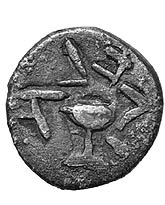
This coin was found at the archaeological dig at Gamla in the Golan Heights,  often called the Massada of the north. The coin says "For the redemption of Jerusalem the (H)oly". It is from the Great Revolt against the Romans in the first century CE. The coin is one of six found at Gamla and it is said that they were cast there in Gamla as well. Its message is not lost on us. Even though these Jews were carrying on their battle in far away Gamla the aim of the revolt and the purpose of the battle was not merely survival but 'the redemption of Jerusalem'. Jerusalem's survival requires Jewish settlement in the rest of Land of Israel.

I won't be giving away any secret if I tell you that Jerusalem is my favorite place in the world. I spent some very happy years here. David and I were married overlooking the Old City. It is with great joy and an enormous sense of gratitude to God that we make our home here once again. I am certain that those of us who live here and all of us who bear witness to the miracle of the State of Israel with the united city of Jerusalem as its capital are aware of the magnitude of that privilege.

Since arriving in Jerusalem I have been having a wonderful time discovering what's changed and rediscovering the familiar in the city I used to call home. There are so many possibilities for learning and cultural events and so many new things to see and do. I don't think I'll ever be bored again. And of course if your want a centrally located place to get together with friends from all over the country Jerusalem would be a great choice. That happened last week. A Facebook group of ladies who coffee klatch virtually, which my good friend Batya Medad -- who has been my friend since before the Internet was even a gleam in Al Gore's eye -- added me to it. We got together for what we call F2F (Face to Face) right here in Jerusalem. It was a lovely day for connecting and connect we did. I think everyone knew someone in the group 'from real life' but no one knew everyone. The conversation flowed as we got to know each other and learned about the challenges and victories of life. Sharon Doubler Katz, described it nicely as did Rachel  and Ruti.

Three of my new friends live in or near Netivot and they shared their feelings about living and raising children under fire. Yes, while I enjoy my new life here in Jerusalem my friends in Netivot are exposed to this day in and day out: Take fifteen seconds to watch the clip below. Go ahead, but first turn down the volume, especially if you're reading this at work or there are children asleep in your house.
Now read what my friend Miriam says. And another gave her take on Batya's blog under the name Netivotgirl. Another woman, mother of 7 children all under 15, told of children afraid to go to sleep and younger ones not sleeping through the night because of the booms. 

It's important for all of us to keep in mind that while we are safe at night others in the south don't know if they will sleep through the night. It's important for us to keep these people in our thoughts and prayers. AND it's important to remind our leaders that this is not a situation we should get used to living with. 


Friday, February 17, 2012

Welcome Ye'elah Tzohar!

Last Wednesday the country celebrated Tu B'shvat, the new year of the trees. The very  next morning my daughter-in-law and son were in the nearest hospital delivering a new baby girl to the world. They called from the delivery room to tell us about this little (actually not so little - over 4 kilo - 9 pounds!) miracle which God sent.  
Friday I went to visit the newbornYe'elah, barely a day old, in Sroka Hospital in Be'er Sheva. 
I joined big sister  Gali now 3 years old and big brother Eytam  who will be 5 in a few weeks. Ye'elah, who had not yet been named slept peacefully through the visit. 
 She was born the day after Tu B'Shvat, the new year of the trees, a time when the almond trees begin to bud. In Israel it has turned into a celebration of nature. 
We wouldn't have been surprised if she were named for a tree or a fruit. Her name reflects the family's love of nature and alludes to the graceful  Negev gazelle and is used poetically to allude to a graceful and gracious woman. 

Now I have to add a picture to my banner. I will wait till I can get a shot of her with her eyes open


Wednesday, January 11, 2012

Feminism

What really defines me? 
I'm working on a new banner since some of the photos in the present one are really outdated. (Some change faster than others!) I also noticed that the subtitle really needed to be updated. So I fixed that too. I chose seven words for what's really important in my life. 

I put feminism first. 
Little girls, growing girls, adolescent girls, women need to be able to view themselves positively and grow up expecting to be treated fairly in the workplace, in law, politics and leadership, in educational opportunities and in the workforce. We need to be comfortable with our femininity and our boundaries need to be respected. 

That means I'm for: 
  • Equal pay for equal work and the corollary that women not be penalized or discriminated against because of child care issues. If we don't have a really good system of day care then we need to compensate for that with extended maternity/paternity leave or some other creative solution. Most of us can't be in two places at once. 
  • Positive encouragement of women in leadership roles in business and government. I will not vote for a party which doesn't have women in prominent leadership roles. I want to see more women involved in running thing at all levels. 
And I am against: 
  • Excluding women from any profession, employment or educational opportunity based on the fact they are women. I once inquired about a government sponsored course in computer maintenance and told by the clerk that he didn't think it was good for me since I might need to lift heavy computers. It didn't work out for other reasons. But really ?
  • Using Misusing women (and children) in advertising. I am annoyed by the pollution of our public spaces and thoroughfares with suggestive and sometimes downright offensive portrayal of women and children. It troubles me when I see women and girls dressing in what I can only describe as degrading. 
What I'd like to see:
Women and men cooperating in making our world (for me that means starting right here in Israel) a safer and more stable place to live. One where women can be what and where they like and not be threatened or viewed as a threat. 
What I don't like to see: 
Man-bashing. It's counterproductive and gives us all a bad name. 

This post will (b'ezrat hashem, bli neder) be followed by others elaborating on the other defining words. 

Friday, November 04, 2011

Soldiers, Sons and Daughters


It is painfully clear that Israel needs a strong well equipped army in order to  defend the country against threats from our enemies. Some countries, like the United States have professional armies where service is a career choice and there is no draft. That's good and bad. Good because it's efficient for training motivated soldiers for service and bad because the burden (and consequences) of army service is not evenly distributed among the citizens.

In Israel we do it differently. Israel Defense Forces (Tzahal) is known affectionately as 'the army of the people'. That's because (in theory) there is universal draft here. By their 17th birthday everyone has received a letter from the army to report for preliminary examinations. Thus begins a series of physical, psychological and aptitude testing geared to finding the right people for the right jobs in this complex organization.

In addition to keeping us sage and secure the IDF figures heavily in educational, economic and social aspects of our country. Through programs like MAKAM which gives young people from problematic situations (drop-outs, disadvantaged, delinquents, immigrants having difficulty adapting) intensive help so that they can serve better and also build up their life skills and help them get further in life. There are special programs for integrating deaf soldiers as well as those with other handicaps into appropriate jobs in the army.

Mystical Paths, a charedi blogger describes his daughter's army service here. (definitely worth reading the whole post)
  "Among general Israel you move from immigrant to real Israeli when you or your child enters the IDF. You’ve joined the ranks of those who have put their blood on the line to defend our common lives and community."
Lives depend on soldiers doing their jobs right. It is dangerous for us to treat soldiers like children. Of course on a personal level, they are our children. (Although I'm 62 my mother still expresses concern about my losing sleep when she realizes that it's sometimes midnight when I call her, so I know that you are always your mother's child.) But, in a world where adolescence is often prolonged well beyond the age of 18 these men and women are trusted with adult responsibilities and all of us have to take that seriously.

This week, Anat Kamm was sentenced to four and a half years in jail for systematically stealing and passing on hundreds of classified documents to a journalist. Her father testified "in her favor" saying that his daughter had not intended to harm state security but was merely “foolish, stupid, idiotic and vapid.”

The court disagreed saying that it was difficult to believe that "the defendant, who has a high level of intelligence, did not understand the meaning, implications and danger of transferring huge amounts of data to a journalist for publication.” They also dismissed the notion that this was youthful folly pointing out that the security of our nation depends on the commitment of  young people to the responsibility of military service which they take seriously and do well.
Our soldiers bear this tremendous responsibility with honor and we owe it to them to treat them as responsible adults.

Here is another heartwarming project of the IDF: (Can't help but love this army!)

Sunday, October 16, 2011

Counting My Blessings

My granddaughter Tamar singing new year greetings learned in kindergarten

The month of Tishrei brings a whirlwind of celebration, soul searching, stock taking, resolution and renewal. I was privileged this year to be a guest at my children's homes this year for Rosh Hashana and Succot. It must be a mother's greatest pleasure to see her children raising their own children and passing on traditions. On Rosh Hashana this year I heard my eldest son lead the morning prayers. I heard him say words of Torah to his students both at home and at the Yeshiva where he teaches. The first night of Rosh Hashana at my other son's house included besides the usual symbols of the holiday a quiz aimed at the younger set which had us all laughing and applauding. Having seven holiday meals in three days gave us an opportunity to do justice to all three families of our married children in Mitzpe Ramon. 

Succot brought another first opportunity. This time we went to the brand new settlement of Naveh in the western Negev. This is where my other son moved from the temporary settlement at Yated. So not only was this the first time we visited him in his new home, it was also the first time he built his own sukka. After the holiday we were joined by my son from Mitzpe Ramon making it  real family celebration. 
This post can best be summed up by the traditional blessing thanking god for having kept us alive and sustaining us and bringing us to this season. 
ברוך...שהחיינו וקיימנו לזמן הזה!


Tuesday, October 04, 2011

Baruch Dayan Emet ~ Rabbi Hanan Porat

report here:  Rabbi Hanan Porat Passes Away 

Over the years that I have lived in Israel there has been no one person who I felt ideologically closer to than Rav Hanan Porat. His total commitment to Torah both in learning and teaching, his commitment to building up the land and people of Israel and his commitment to social justice will probably remain unequaled for a long time to come. It is not just that he said the right things, he lived them. And he expressed these ideas clearly and what I can only describe as gracefully.
His life was a blessing to our people and may the family find comfort in the rebuilding of Zion and Jerusalem.
יהי זכרו ברוך

Monday, September 26, 2011

Preparing for the New Year!

Like my sisters and brothers around the world I am busy getting ready for the upcoming Rosh Hashana holiday. This year the New Year begins on Wednesday night and on Thursday and Friday we gather in our synagogues to hear the shofar blown. Then without any further ado we go right into Shabbat. All this heralds a marathon of eats and on Rosh Hashana we go all out with symbolic foods signifying all the good things we wish for ourselves and our community in the coming year. For a thoughtful discussion of these symbolic foods you should read this post by The Rebbitzin's Husband . You might also be interested in this post of Leora's about the symbolic foods. 
While we're on the subject of cooking for this amazing holiday let me remind you to take a look at the Tishrei edition of the Kosher Cooking Carnival at Cooking Outside the Box a delightful blog with lots of interesting ideas while the Elul edition of the Kosher Cooking Carnival is up over at Me-ander . 
Batya Medad
Rabbanit Yemima intoduced by Tzofia Dorot
 And speaking of Batya, my favorite Shilo resident, I had a lovely experience at Tel Shilo  where both she and I attended the Tfilat Hannah and heard the inspirational Rabbanit Yemima Mizrahi. I hope to write separately about this moving experience.  She was followed by concert given by Leah Shabbat and Tal Bril.
The event was organized by Ancient Shilo which runs tours of the archaeological dig at the site where the Tabernacle stood. Besides Batya I also ran into a very good looking reservist who was called up especially to guard us and the approximately two thousand other women and young girls who attended this event. This particular reservist also worked as a guide at this site when he lived in the nearby settlement Eli. He also happens to be my son. How thoughtful of the army. 
Reservist Shayke Tzohar 

Monday, July 18, 2011

It's all about perspective

These last few weeks have gone by in a haze of almost normalcy here in Israel.
The New York Times even ran an article showing Israel in a downright positive light proclaiming: Where Families Are Prized, Help Is Free
 Jewish and Arab, straight and gay, secular and religious, the patients who come to Assuta Hospital in Tel Aviv every day are united by a single hope: that medical science will bring them a baby...
...Demographics here are also political. Israel has historically focused on promoting Jewish birthrates to retain a Jewish majority and more recently as a counterweight to higher fertility rates of Palestinians in the occupied territories. Arab citizens of Israel, however, have the same rights to state-paid fertility treatments as their Jewish counterparts.
While Libya, Egypt and Syria are dealing with the 'Facebook revolutions' involving violence, overthrowing governments and gunning down opponents, we have had our 'Facebook uprising' involving the price of cottage cheese and this week it's the price of rentals for students in downtown Tel Aviv.
There is comfort in the middle-class-ness of it all. You could close your eyes and almost  imagine we are a regular bourgeois country.
But the conflict hasn't gone away. However if Facebook and Youtube have become the venues for change take a look at this latest entry in the war of our legitimacy in the region. Think about it and pass it on. 

Wednesday, May 18, 2011

Hair we go again!

This week's Haveil Havalim is here.
Chaviva of Kvetching Editor fame is doing a series called The Tzniut Project where Jewish women are answering questions about " their practices, people's assumptions, and more" regarding what is being called tzniut (modesty) but really in this context is about dress codes. One of her questions is: 
"What do you think other people infer from your clothing and hair covering choices? Has anyone ever said anything to you outright that expresses a judgment based on your appearance? (Ex: “You don’t cover your hair or wear skirts, so why do you keep kosher?”) 
Funny you should ask.
Last night the phone rang and it was a survey about a newspaper we subscribe to. I usually cooperate with phone surveys because it gives parnasa (support) to a Jew in Israel. So I tell him on a scale of 1 to5 what I think of various sections of the paper, whether on a scale of 1 to 4 I will subscribe again next year, on a scale of 1 to 7 whether I agree or disagree with certain political  and moral statements, etc., etc. And then the young man got to the demographic section. So, how do I define myself. Well, there was a really broad spectrum  from haredi, haredi leumi, dati leumi, dati, masorti leumi and several other configurations that I don't remember this morning. I picked one and then we went on to the next question obviously designed to further sharpen the demographic division:
How do you cover your hair? 
which was followed by a list of possibilities from 'always a wig' through 'sometimes a wig and sometimes a hat', 'only hats and scarves covering all or most of the head', 'hats and scarves covering most  but not all of the head' 'some of the head', sometimes, always, never???  The next question was about pants. 
Conclusion: around here there seems to be plenty to be inferred from my hair covering choices!

Monday, April 11, 2011

An End In Sight?

Halutza, May 2010
Esser Agaroth: Haveil Havalim #312 - It's Time To Talk About The Elephant In The Room begins with a discussion by Ya'aqov Ben-Yehudah, this week's esteemed host, of pluralism which I guess would mean including all the posts submitted vs.editorial selection and exclusion of posts which the host deems 'offensive'. Ideally, I come down on the side of inclusion, except that I know that when I hosted there were one or two posts that I did not include because they were from missionary type sites. So, I guess we all have our boundaries for good taste. It's good to talk about it and if a host does disinclude a post it should be noted why. Thanks Ya'aqov for a thoughtful and well done review. (I like it when you can tell that the host actually read all the posts.)

Bibi Netanyahu is talking tough (here) about meeting 'further fire' with a 'harsh response'. In the meantime the Hamas has escalated the shelling only to be thwarted by 'Star Wars" style technology. Iron Dome. Today, as the Viflic family face grief and sorrow of watching their only son Daniel fight for his life in Soroka Hospital  (Iron Dome does not protect school busses from anti-tank missiles) there are some mumblings from Gaza about a 'cease fire'. But as has been pointed out, there has been not one month since Cast Lead without shelling from Gaza.
In some personal news my son's family has moved from their temporary settlement in Yated to the new home of the Atzmona Pre-military Prep Yeshiva in the new settlement Naveh in the sands of Halutza. The place is so new that Google maps doesn't even name it. But it is really close to where they were temporarily.
View Larger Map
I can not help but see the irony here. Atzmona is a settlement which existed in Gaza and it's residents were exiled  in 2005 in order to 'give peace a chance'. So far the least cynical thing I can think of to say is that this is ironic.
Not exactly Gaza, but definitely in the same vein, I'd like to share this video of a constructive initiative. A hearty Kol Hakavod (more power to them) to these women in Gush Etzion: 

I am looking forward to a week of Pesach preparations and I hope to be thinking mainly about matzoh.
Happy Passover! !פסח כשר ושמח

Sunday, March 20, 2011

Happy Purim!

Happy Purim!
Photos taken on Friday morning of children on their way to pre-Purim celebrations in the kindergartens and elementary schools. 


OK, not really a costume!
More Straight Out Of the Camera 

Friday, March 18, 2011

Wild flowers, spring and hopes for better times

Wild flowers
Yesterday we fasted the 'Fast of Esther' commemorating the fast Esther and the Jews kept before she risked her life to go to the king and get Haman's decree revoked. Tonight we will be lighting Shabbat candles and tomorrow we will read the 'Zachor' describing the attack by Amalek on the weakest of the travelling Israelites during the travels in the Sinai after leaving Egypt. The tradition is that Haman, the villain of the Purim story, was descended from Amalek and so we read this portion which includes a commandment to remember (zachor זכור means remember) the attack by Amalek and wipe out Amalek.  This public reading is done on the Shabbat before Purim and both men and women are required to hear the reading. Then on Saturday night we will be reading the Purim story and celebrating yet another deliverance. 
In the Megilat Esther (the Purim story is read from a scroll named after Esther) there is not one mention of the name of God. How could that be? How could there have been deliverance without God's intervention. There have been many many interpretations given through years but the one that rings especially true this year is that God is not mentioned in order to show us that the evil decree is an example of hester panim (when God figuratively hides his face) as the word hester is alluded to in the name of the queen Esther. The deliverance came not by supernatural miracle - as in the parting of the Red Sea - but through Esther's brave deed along with the moral support of Mordechai all the Jewish people. This teaches us to look at all of life as a miracle through which God manifests his presence in the world. Sometimes his plans for the world are in tune with our expectations and we consider that state 'natural' and other times it is harder for us to accept events because we fail to see their meaning. This week has been one of those weeks when it is difficult for us to understand God's presence in our world. 

This week began with the funeral of the Fogel family of Itamar.Over 20,000 people accompanied them to their graves. It was difficult even to watch the broadcast and I can only imagine what it must have felt like to be there in person. All the eulogies were emotional and raw reflecting the shock of the brutality. The former Chief Rabbi of Israel Rav Yisrael Meir Lau, who was the youngest survivor of the Buchenwald concentration camp (7 years old at the liberation) said
"it appeared as though the cycle of terror closed 66 years ago, when the blood of infants was spilled like water, when a million an a half children were trampled at the hands of beastly people.  "Sixty-six years have passed. We announced a State, we achieved independence. We established the magnificent Israel Defense Forces. And still, this cycle of terror and the river of blood flows, and we stand here helplessly." 
In addition he addressed remarks to twelve year old Tamar Fogel saying that she will now take on a role of 'little mother' to her surviving brothers (8 and 2 years old) who will have to be the 'kaddish' for their parents' memory in the years to come.  I noticed many well-meaning folks, mostly women, who felt that this thought was out of place. Let the little girl remain a child. Don't burden her with this responsibility. Would that we could! But Rav Lau knows different. His life is a testimony to to just how resilient a child can be. But no matter how much everyone wants to help, and will help, those children will ultimately share with each other an emotional tie that is like no other. .
(If you haven't read his autobiography אל תשלח ידך בנער in Hebrew you will apparently be able to read it soon in English and everyone should read it!) 
Cyclamen
And in another one of those weird 'only in Israel' ironies an IDF army medic saved a new born Arab baby girl in the Neve Zuf settlement where the Fogel's parents are sitting shiva. 

It's been a sad week for us in Israel and around the world. The earthquake in Japan and the bad to worse condition of the nuclear power plants have yet to be fully understood. When we empathize we usually call upon a similar emotion or reaction in our memory to help us feel the pain of others. But the horror that is happening in Japan, I have no parallel experience to call upon. I can only imagine. Japan is the only country to have experienced nuclear fall-out and that was in wartime. I always imagine that what Japanese must feel towards nuclear destruction is similar to the horror which we feel about the Holocaust. I am trying to imagine an earthquake killing thousands followed by a Holocaust and no end in sight.
Anemones


And so it goes. Life is made of cycles, grief and danger, joy and deliverance. Through all of it certain things stay the same. The winter is drawing to a close and next week is spring solstice. There are wild flowers blooming in Rehovot and as the seasons change the flowers bring hope of nature's renewal.
And now we can only pray that God bring order back into our lives and give us strength to go forward. 
עושה שלום במרומיו 
He who keeps the peace in his world 
הוא יעשה שלום עלינו
He will bring peace (and order) upon all of us 
ועל כל ישראל
And on all Israel 
ונאמר אמן
And we will say amen!

Sunday, March 13, 2011

We are all Settlers!

So, we unplug ourselves for Shabbat and then after Havdala we realize that while we were happily enjoying ourselves with our children and grandchildren in Mitzpe Ramon a family was murdered in their beds in Itamar a settlement in the Shomron.
This morning, the first person I spoke to asked me how my Shabbat was.
I replied that Shabbat was lovely, until it ended and we heard the news.
He asked.
"Did you know them?"
Did I?
They were a couple in their mid-30's with six kids, none of them yet even in their teens, living in an isolated settlement with a fence around it keeping Shabbat, teaching Torah and building Eretz Israel.
Do I know them?

Wednesday, March 09, 2011

International Wormen's Day - We Could Be Doing A Lot Better!

Hannah Katsman brought a few quotes from  an interview with Tzipi Hotovely in HaAretz over at A Mother in Israel along with a reaction by Elana Stzockman. 
The interview is the of the genre we've been seeing for the past few days leading up ti Internation Women's Day. You know, that day when at work they give you a rose and the  the newspapers and radio (probably TV too) are busy hurling statistics at us. So we've heard this week that over more than a century of  Zionist civilization women in Israel are living longer than men but earning less (here). It's painfully obvious that although women have had the vote from just about the start of the Zionist movement there are still only 23 women in our 120 member Knesset. And on the managerial fron: of 4,820 positions on corporate directorates in Israel 590 are women (more statistics here in Hebrew).
So, Ha'Aretz asks the 32 year old Rehovot resident Knesset member Tzipi Hotovely if she has come up against a glass ceiling. Well, they may have found the one of the very few women around who hasn't (yet) hit the glass ceiling. The young legislator also says that when she has a family of her own it will be necessary to set different priorities where her career is concerned. This really enrages Stzockman who calls Hotovely naive and condescending and ignores a lot of important bills she and others have introduced to ensure quality daycare and more reasonable maternity benefits. I would send her over to read Avirama Golan's brilliant description of a 33 year old pregnant woman getting ready to join the ranks of those "combining a career and family" in Israel:
"This nasty phrase is the front for an entire system of social codes, all of which demand the young woman be an exemplary mother who will nurse her baby, take him to all the developmental groups, and swimming and yoga classes; that she be an excellent cook and a sweet wife; but also that she keep her trim figure by taking exercise classes, and give off an aura of sexiness (but not too much, of course ) and charm - and all of this without losing the momentum of her success at work." 
and concludes 
"Instead of a holiday, could we perhaps just have a little rest?" 
 We have a long way to go. We need to make it possible for women with young children to work outside their homes and earn more than it costs to keep their children in daycare. We need to recognize that professions like teaching and social work deserve compensation that equals hi-tech, advertising and engineering, and that keeping society educated and stable is at least as important as keeping the electricity flowing.

Sunday, February 13, 2011

25 Years Since Natan Sharansky Returned Home

Don't forget Haveil Havalim at The Rebbitzin's Husband!
So where were you on February 11, 1986? Me? I was living on a farm in the Golan Heights raising 5 kids and wondering how it would all work out. I had been living in Israel almost twenty years. I'd seen the euphoria of the aftermath of the Six Day War turn into the pessimistic depression of the aftermath of the Yom Kippur War. In 1975 we moved to Ramat Magshimim where all six of our kids were born.
The seventies ended with the upheaval caused by the Likud's Menachem Begin forming the first ever government not run by Labor. They made peace with Egypt and instituted far reaching economic changes. Our middlemost daughter (at the time our youngest) was a few months old when the whole moshav (or just about) went down to Yamit on Chanuka to express our solidarity with the settlers there on the eve of their eviction.   The twins were born the following year during the first Lebanon war which we called Shalom HaGalil (שלום הגליל) and it was meant to bring peace and quiet to the settlements along the northern border. By 1986 Peres (Labor again) was Prime Minister and Yitzhak Shamir was Foreign Minister. Inflation was rampant and we were in need of some good news.
In February 1986 the Kinar resort on the northeastern shore of the Kinnert was just being finished and had not yet opened for business. My older daughter (8 at the time) and her friend were taken down there one afternoon a few weeks after Sharansky came home and she was very excited when she came home because she and her friend had seen Natan and Avital walking along the beach. (She told me, they didn't go over to them because they knew that they needed to be alone together and it was a secret that they were there.) When she told me the story you could see that it was as if she had glimpsed the fairy princess and her prince charming. Such is the Zionist mythology. For us, this is our nobility.

An ironic footnote. Sharansky was released in exchange for two Russian spies handed over the US. It was about two and a half months after Jonathan Pollard and his wife were arrested. Pollard remains in jail in the US. 

Wednesday, February 09, 2011

Song Worth 1,000 words!


I've got to admit that US President Obama and his Secretary of State Clinton's  reaction to the 'student unrest' in Egypt came across to us ex-pats here in Rehovot (representative sample of 2, me & David) as being only randomly tangential with reality. It was a flower children view of 'protest' conjuring up Pete Seeger-esque scenes. Sandy Cash, who is maybe a tad young to remember the sixties has captured the spirit of our response in this lovely ditty she posted on Youtube.
Apropos Sandy here's a personal favorite of mine.(non-political) Enjoy!

Wednesday, November 17, 2010

Memories and Music in Gedera (of all places)

Gedera holds pleasant memories for me. When I came to Israel after the Six Day War in June of 1967 our group ended up right near Gedera. There wasn't much to do after we finished work, so we ended up going to Gedera a few times, mostly on foot. Once we got to Gedera we usually had a felafel and a drink at one of the two places on the main road. For lack of much else to do we watched the traffic on the road. What we saw was mostly tanks and other military vehicles many of which still bore the Egyptian markings. These were the spoils of war being transported.  
Gedera was founded by members of the Bilu movement in 1884 and was one of the first settlements of the modern period. The main street in Gedera is Biluyim street after these first settlers. It is tree lined and is home to some very nice restaurants and galleries set up in these renovated old homes.
Badolina is a cafe and bakery in Gedera. We celebrated my daughter's college graduation there a few years ago so I have particularly warm feelings about the place. The food there is very good and they have really excellent cakes. Badolina has a new branch in the restored Port in Tel Aviv which was the first and for a long time איקonly kosher restaurant in the area. 
This week we spent a lovely evening in the yard listening to the brothers Ehud and Shachar Ariel sing accompanied by guitar and harmonica and a drummer who drummed on a wooden box. They performed mainly songs by their father, the late Meir Ariel.  
Meir Ariel (from the official site)
Meir Ariel was a paratrooper in the Six Day War and helped liberate the Old City of Jerusalem. He later recorded a song to the tune of Naomi Shemer's Jerusalem of Gold called Jerusalem of Iron. It was considered at the time very cynical because he mentioned smoke and blood and the black of mourning the soldiers.After that he lived in the US for a while where I guess he picked up his own style. His songs are in the vein of Bob Dylan in his folk-rock period and some of them lean toward blues. You know, the kind of music that appeals to those of us who came of age in the sixties. (Remember don't trust anyone over 30? sigh) The evening was very successful. We arrived early and heard the performers warming up. The weather here has been warm so sitting outside was very pleasant. (We are praying for rain, should I feel guilty for enjoying the mild weather?) and in honor of the occasion I even had a drank a glass of sparkling wine. David had beer. We also ordered some light food to nosh on which was very good. I had salmon in teriyaki on skewers served over a salad and David had penne noodles with mushrooms and cheese.
The music was great. Ariel's two sons have become religious and sometimes it seems a little incongruous because this is not what you would associate with Breslever Hassidim. Well, that's not totally true because Shuli Rand does music in this style but his lyrics are of a more religious nature. Ehud is a very talented guitarist. The drummer Omer Seri was amazing because instead of a set of drums he sat on a box and drummed on it. They did add a medley of Jewish songs and the audience sang along enthusiastically. (It is much easier to sing along with these songs than with the folk-rock - at least for me.) All in all, we agreed that it was a very special evening and look forward to doing this again some time.

Monday, November 15, 2010

Creativity in the face of challenge

Raise Your Spirits Theatre is a community theater group in Gush Etzion founded by Sharon Katz and Toby Klein Greenwald. The group puts on shows which involve many women in the planning, production and performance. Any profits are channeled toward helping victims of terror, families in need, emergency medical equipment and other needs.                                                                                   
"In 2001, amidst an atmosphere of grief and terror,a group of women in Gush Etzion joined together to the raise spirits of their community and all of Israel. Rather than succumb to the depression caused by daily terror attacks, they decided to start a project that would give them a positive outlet and something wonderful to look forward to. They decided to put on a show. The rest, as they say, is history. (from their website)"
Orthodox Jewish women don't have a lot outlets for their creativity if they are talented in the performing arts. But in the last generation there have been some serious efforts to encourage more opportunities. Emunah Teachers College in Jerusalem has a drama department and Orot Israel College in Elkana has a dance department. The graduates of these programs have been working in girls schools around the country setting up classes and in some cases departments where the girls of the religious Zionist community can learn, practice and perform.
The Raise Your Spirits group is different. This group is a group of everywomen or at least a nice cross-section of ages and interests. Some families even had three generations participating.
The book of Judges שופטים is the story of the early years after the Jews entered the Land of Israel and is about their struggle to conquer and rule the land. After Joshua's time there was a lack of central leadership and ups and downs regarding faith and unity among the people of Israel. Many see parallels to our situation today.
The Song of Devora is an upbeat story of charismatic leadership, faith and inspiration. The writers Toby Klein Greenwald and Yael Valier reach out and ignite our imaginations and the music by Mitch Clyman makes you want to get up and dance. Speaking of dance Sara Orenstein is an honors graduate of the Orot Israel dance and education program and did a fantastic job.
The performance is a patchwork of scenes which set the background to the story and then introduce each character center stage all leading to the great confrontation. The performers, some have professional training but most are just regular folks, carry this off beautifully. All through the show, besides performing admirably they show us that they are not just individual performers but a cohesive unit and most of all they seem to be having a really good time.
After all the finales we were asked to stand for Hatikvah and Ani Ma'amin. The auditorium at the community center in Gush Etzion became a very intimate place as the dozens of players and production helpers who were on stage face the scores of women in the audience and sang together. In those moments you could feel the unity and faith that is the common denominator for all of us there. It was very very special and I hope to see more of these moments.

Monday, November 08, 2010

Protection on the ground and in our hearts

Yesterday I traveled to Tel Shiloh for the the Rosh Chodesh visit to the site where the Mishkan (tabernacle) stood for 369 years and where Channa prayed to God to grant her a child. She become the model on which our sages based the halachot (rules) for prayer, until this very day.
The tel overlooks the road which goes from the Shiloh settlement to Eli and onwards to Ariel.
Once again we witnessed an 'only in Israel' moment!
At the tel we met a group of soldiers fully equipped who were passing through. One of them took out tfillin and put them on. As they were leaving I asked them how they happened to be in the area and they explained that they were on patrol. The Hebrew word for patrol is si'ur (סיור) which is also the word for touring around and so it could also mean just passing by and looking at the sights. So we joked with them that they were protecting us with their prayers  as well as their guns.
I had a wonderful time having spent the rest of the day with f2f with Batya eating a healthy lunch and redecorating her blogs.
Chodesh Tov!

Monday, November 01, 2010

What Women CAN do!


RivkA bat Yeshaya of Coffee and Chemo was a longtime member of the Shirat Sara a women's tefilla group which meets regularly in Jerusalem. This is a post on a subject I began writing a few times since Simchat Tora and now I dedicate it to her memory. 


It has been established that men and women should be separated during the rituals and worship.
Gender separation is a defining characteristic of the Orthodox synagogue, especially as this became a hotly contested issue in the US in the middle of the Twentieth Century. The Talmudic source is Sukkah 51b  which tells of the Simchat Beit Hasho’eva in Temple times. While men and women were in separate sections, this proved inadequate to maintain decorum during this festive occasion, and it was decided to build a balcony for the women. It is fairly remarkable that the authorities of the time changed the design of the Temple, since it was designed by the Architect of architects, but that shows how serious the issue was. In an open letter Rabbi Soloveitchik described the fundamental importance of gender separation in synagogue. He said that separation is biblically required, while the mechitza is rabbinic.(more discussion here)
(As a child I remember commercials for "the family that prays together, stays together" which it turns out was a commercial for Catholics - who knew?) Clearly this did not apply to Orthodox Jews. Even in shuls where there was mixed seating the women were just there, alongside but not participating.

In the 70's that began to change..In the Reform movement Hebrew Union College admitted a woman to its rabbinical ordinations program. Some Conservative synagogues began giving aliyot to couples (the woman accompanied the man when he blessed the Torah). In the Orthodox community we began examining the possibilities.

One avenue was to separate and set up a minyan  (quorum of 10 required for public prayer) for women. On closer examination we found that ten women (or 100 or 1,000) don't make a minyan. But still maybe there were ways we could remain within Orthodoxy and still have more participation.

Reading Megillat Esther (Book of Esther) turns out to be something that women have an equal obligation and according to most can read the megilla and recite its blessings. (See "Women's Megilla Reading" by Rabbi Aryeh A. Frimmer here.) These readings are especially delightful for me and I attend them whenever I can. Here in Rehovot we have one in the morning at our synagogue and I know of several other places  where women read the Megilla. This has become a very widespread practice in certain circles in Israel. RivkA organized , participated in and taught her daughter to read Megillat Esther.

Sara Friedlander Ben-Arza, a poet, editor and lecuter in the field of  chasidut, midrash, piyut and music wrote an eloquent article in the Succot edition of Hebrew newspaper 'Makor Rishon' about the Shirat Sara women's prayer group of which she is a member. (Unfortunately the article is not online.) The group was organized to celebrate the Shabbat Kallah (Shabbat before the wedding) of a woman around 16 years ago and later was named in memory Sara Rachel Duker one of the participants who was later killed in a Jerusalem bus bombing. The group meets at intervals of five to six weeks. The women sit in a semi-circle and sing the prayers together. They sing the parts they would be saying if they were praying individually but not the parts that require a minyan which would turn the service into t'fila b'tzibur (public prayer). The Torah portion is read from the Torah scroll. As each woman is called up they recite a verse in lieu of the Torah blessing and another one at the conclusion of the section. The service includes lessons in Torah and Jewish law as well. Sara Ben-Arza points out that the young girls who attend these services are growing up with the expectation that they to will take their place next to their mothers and make this a tradition. See RivkA's proud post about her daughter's Bat Mitzvah here.

I participated in a service at Shirat Sara and it was a wonderful experience. It is not a mimicking of a 'real' service but something else. It is uniquely feminine and you can feel the effort, preparation and love that goes into making this so special.  Ben-Arza's article describes how the group deals with the halachic issues. This search for alternatives then brings the women a deeper study and understanding of the prayers and the solutions are just that much more meaningful because of this confrontation.

I like the Shirat Sara model. If I lived in Jerusalem I would be there often. There is a lot of preparation that goes into the Torah readings and it will be a long time before we have enough women who can deal with that kind of preparation on a wide basis. Here in Rehovot there have been a few Bat Mitzvah celebrations where the young lady prepared the Torah reading and her friends and family came and a service was held. It is, of course exciting and uplifting to participate in these services as well. But it does not come close to a group that meets at regular intervals.

But there is a tension between the two worlds that the women live in. The group doesn't meet every week because they want to stay connected to their community and family. This way most of the time they are part of the general community and on these special weeks they are part of their own special women's community. One of the wormen put it this way:: "On the other Shabatot I pray in a regular synagogue. There I am not an integral part of the community prayer experience. In that setting which halahically is tefilla b'tzibur (public prayer) I feel as if I am praying as an individual. But at the women's prayer service  which is not technically deemed t'fila b'tzibur  I feel the experience of participating. In the women's service I am the community. My absence would be noticed."

With the passing of RivkA these remarks take on another meaning. RivkA personified the modern Orthodox Jewess taking the tradition building on it to include our womanly connection. Her absence will most certainly be noticed.
RivkA bat Yeshaya
רבקה בת ישעיה
יהי זכרה ברוך
Related Posts with Thumbnails