Pages

Showing posts with label History. Show all posts

Monday, October 21, 2013

Teaching Jewish Girls in the Shtetl!

Greiding, Ukraine c. 1900
Binyoumin Kreplach and the class of girls
The girl, top row second from the left is my grandmother Rissel the Ruta (the readhead!) and this picture was taken in Gorodok/Horodok, Ukraine where she was born around 1888. The teacher's name was Binyoumin Kreplach who gained this name having once expressed his yearning for yesterday's kreplach one Yom Kippur afternoon. Small town's don't easily let you live these things down. It seems this didn't spoil the shidduch because the little boy to the left of Mr. Kreplach is his son.

Rissel Schwartz
official ID photo
My grandmother Rissel Schwartz left the shtetl for Odessa where she lived with cousins and studied in a Gymnasium which as I understand was a secondary school, like a high school. I guess she must have learned enough from Binyoumin to hold her own in the school.  She was there during the revolution but immigrated along with her brother to the United States around 1922.

I would love to have asked her questions about her childhood and education but unfortunately she passed away a few months before I was born and I am named for her.


Wednesday, August 07, 2013

Aliya Today

It's that time of year again. Nefesh B'Nefesh  has the Internet buzzing with live broadcasts of olim arriving early in the morning at Ben Gurion airport to the cheers of bleary eyed veterans who come there to meet them. Everyone is smiling and crying tears of joy.
Around our virtual campfire (Facebook) folks who came here pre-NBN reminisce about what it was  like 'before'. NBN has only been around for the last decade and has certainly revolutionized the immigration process. Many of the arrangements that took weeks of running around and filling out forms at different venues are now done at the airport or at central meeting places where the newbies are helped with opening bank accounts and signing up for health insurance, all of which make the process smoother, I'm sure.
Deep down under it all, all of us who choose Israel as our home arrive with an uplifting feeling of pride in the country mixed with a certain fear that we and the country will not live up to our expectations. Like every relationship we will become more realistic as we  go along. But those first impressions, those first heady days, those patting ourselves on the shoulder moments, those 'this is actually happening' feelings, they help us in our new role as immigrants.


My own first hours in Israel were just a few weeks after the Six Day War (which has become ancient history it seems).  My most vivid memory is of going with my friends to Tel Aviv where just about every balcony had an Israeli flag hanging out. The flags were in honor of the liberation of Jerusalem and in celebration of the survival of the State of Israel when just a few weeks before many had not been certain that this Zionist experiment would live out its second decade. That euphoria is sort of like the laughter after  a particularly scary roller coaster ride, you know the kind where you ride a loop that has you completely upside down and you doubt your sanity. When it's over your laughing from relief. Only this danger was real. And then it was miraculously over. (Or so we thought.)
Thank you Facebook friends for that trip down memory lane and thank you NBN for bringing home so many more American Jews.
 And to our new citizens:
!ברוכים הבאים

Monday, January 02, 2012

Post Box Rehovot

Risa, coming to you from beautiful downtown Rehovot reporting on a historic "find". A genuine relic of a bygone age. You heard it here first. (maybe) 
This post box is a reminder that from the end of the World War I until the declaration of the State of Israel on May 15, 1948, Palestine was governed by Great Britain as a mandate of the League of Nations. With 63 years of paint it might be just a bit difficult to see but there is a crown there above the words POST OFFICE.

Monday, July 18, 2011

It's all about perspective

These last few weeks have gone by in a haze of almost normalcy here in Israel.
The New York Times even ran an article showing Israel in a downright positive light proclaiming: Where Families Are Prized, Help Is Free
 Jewish and Arab, straight and gay, secular and religious, the patients who come to Assuta Hospital in Tel Aviv every day are united by a single hope: that medical science will bring them a baby...
...Demographics here are also political. Israel has historically focused on promoting Jewish birthrates to retain a Jewish majority and more recently as a counterweight to higher fertility rates of Palestinians in the occupied territories. Arab citizens of Israel, however, have the same rights to state-paid fertility treatments as their Jewish counterparts.
While Libya, Egypt and Syria are dealing with the 'Facebook revolutions' involving violence, overthrowing governments and gunning down opponents, we have had our 'Facebook uprising' involving the price of cottage cheese and this week it's the price of rentals for students in downtown Tel Aviv.
There is comfort in the middle-class-ness of it all. You could close your eyes and almost  imagine we are a regular bourgeois country.
But the conflict hasn't gone away. However if Facebook and Youtube have become the venues for change take a look at this latest entry in the war of our legitimacy in the region. Think about it and pass it on. 

Thursday, March 24, 2011

Thursday Challenge - GREEN

This photo was taken this summer in the Biriya forest in the Galilee.

The Jewish National Fund has been responsible for reforesting projects in Israel (and before that when Palestine was controlled by the Turks and then by British Mandate) making us the only country to finish off the 20th century with more trees growing than at the beginning of the century! 
Read more about the JNF here 
See more Thursday Challenge here.
Two more photos from that trip:
Birds in the Biriya Forest

Olive Trees in the Galilee 

Thursday, January 27, 2011

One Melody - Two Renditions

Modzitz is well known as THE most prolific and melodious of the chassidic dynasties. The founder Reb Yechezkel of Kuzmir zt"l was a student of the Baal Shem Tov. the founder of the chassidic movement. The history of the group is fascinating and you can read more about it here in English. The second Modzitzer Rebbe, Reb Shaul Yedidya Elazer Taub zt'l escaped Poland to the US in 1940 where he remained until 1947 when he came to the Land of Israel to join his son Reb Samuel Eliahu Taub zt'l, with whom he had traveled to Eretz Yisrael in 1935 and who had remained in Tel Aviv with his family. Reb Shaul arrived in 1947 to join his son and lead the chassidut. He took ill and died on November 29, 1947, the very day that the UN voted on partition. He was immediately buried on Har Hazeitim (Mt. of Olives). He was the last Jew to be buried there and his family did not even have a chance to put a stone over the grave. It was not until Jerusalem was re-unified in 1967 that the family was able to do this. The musical chassidic court thrived in Tel Aviv and later moved its headquarters to Bnai Brak.
Over the years the rebbes and their followers have composed and sung hundreds of melodies. But, as happens with folklore, the melodies were sung but not written down (none of the rebbes had musical training). All that is changing now. There is a group (site only in Hebrew) which is recording the melodies and archiving them. They are collecting tapes and interviewing chassidim and have published two disks already.
Both David and I like this kind of music. A few weeks ago we attended a concert in Tel Aviv by the Israel Philharmonic Orchestra, the Yuval Cantors Choir and five guest cantors in a program of chassidic music. It was amazing! The clip below is of a Modzitz melody. (recorded with my still camera acting as a video so the quality leaves much to be desired but you get the idea)


Now, listen to real chassidim singing the same melody celebrating Tu B'shvat. (The melody starts around 5 minutes into the video right after the l'chaim.)

Enjoy!

Thursday, January 13, 2011

Aging in the Computer Age

Computers for Every Age is the name of a program for helping older adults learn to operate and enjoy our digital age. Yes, the Government of Israel and American Jewish Joint Distribution Committee started this program to help golden agers take advantage of the computers and especially the Internet. Last week I became a volunteer instructor in this program. I tutor one on one in a special classroom with a  few computers in the offices of Aleh (על"ה) which is Rehovot's very own Association for Aiding the Elderly. It's been around since the 80's with the mission of improving the quality of life for Rehovot's elderly.
Lecture about Internet use at Cafe Aleh this week
Besides the dedicated lessons there are also two computers connected to the Internet to be found in the Cafe Aleh in downtown Rehovot. The lovely cafe, run by volunteers serves coffee and cake all morning and folks come in to be together, socializing or playing cards or reading the newspaper. They have two computers connected to Internet and a few times a week there is someone there to answer questions and give tips about using the computers. On Wednesday mornings I am that 'expert'.
Many of the folks I meet are using a computer for the first time. I show them how to use email and to search for articles and sites in their field of interest. Another popular topic is using the Internet for making doctor appointments through the various HMOs here. Not surprisingly a big hit with this crowd is using Skype to keep in touch with the children and grandchildren.
Besides helping introduce people to the fascinating world of modern communication. meeting people at Cafe Aleh is an education in modern history. These people, in their seventies and eighties are the generation that built the state. They are the younger survivors of the holocaust, the young soldiers of the infant Israel Defense Forces and the young people who came in groups with Aliyat Hanoar (Youth Aliya) before their parents or without their parents in the early days of the State. They are people who remember the ma'abarot (temporary housing) in one of the worst winters Israel has seen (1950 when it snowed even in Rehovot).
I am learning just as much as I am teaching!

Monday, November 29, 2010

Two Rabbis, A Rebbitizin, A Rabba and Rabbanit and one more Rabbanit

Moderated by Rebbetzin Sharon Freundel
Distinguished Guest Panel:
Rabbi Dr. Aryeh Frimer, Rabbanit Chana Henkin, Rabba Sara Hurwitz, Rabbi Daniel Sperber

I'd like to recommend watching or listening to this discussion (and the two that proceeded it are definitely worth listening to as well here)
The discussion explores the how the expanding educational opportunities for women in the Orthodox world effect the role of women in the community and in the synagogue. I could have listened to these people for another few hours but the discussion was well planned and the moderator (the Rebbitizin) did a very good job of keeping it going. It also helps that the panelists are articulate and committed to their points of view as well as sincere. Although they do not agree this was not a debate and the general tone was that they are all trying their best to be loyal to the Orthodox traditions while acknowledging the changes that are taking place. Rabbi Aryeh Frimmer, as he himself points out "has been in this business since 1972" and has written major articles and given hundreds of lectures on the subject. He has seen himself go from the being among the only Rabbis seriously discussing change to the right-winger on this panel.
It's easy to loose track of what has happened in this area since the seventies. A discussion like this one was  impossible in those years because the questions just hadn't even been addressed. But many of the issues that Rabbi Frimmer addressed over those years have become in his words "non-issues". Take for example the fact that in many Orthodox synagogues women are saying kaddish.
Look at higher Torah studies for women. Rabbanit Henkin's program training Yoatzot Halacha would have been out of the question as recently as 50 years ago. Not only are these women learning Talmud on a high level but they are applying what they learn and women are listening to them. All this was accomplished by steady hard work and serious learning by dedicated students and teachers with a commitment to Torah and a constructive attitude.
Rabbi Sperber's position is more far-reaching and has not become as accepted yet. Although he advocates giving women a more active role in the ritual we have yet to see the Orthodox mainstream adopting this. Rebbi Frimmer is against it on halachic grounds and Rabbanit Henkin gives the impression that now is not the time for it although she is not outright against it. My feeling is it just won't happen, not for a while anyway.
Rabba Sara Hurwitz is the youngest member of the group and this actually put her at a bit of a disadvantage. Rabba Hurwitz is serving in a communal position in an Orthodox synagogue in New York City after being ordained by Rabbi Avi Weiss. There has been a lot of controversy over this step and I confess that I am not convinced. I do not understand what her role is meant to be or what theYeshivat Maharat of which she is the dean is actually intending to do. It seems the idea is to develop Orthodox feminine leadership. Now, that is a good thing, but I don't understand their model. Perhaps it is unfair to compare her with the other three panelists because this is just the beginning but her presentation here didn't convince me that this a constructive path to be following.
All in all, this is an important discussion and it is encouraging to see that we have such learned and talented women and men in our generation. Rabbanit Henkin hit the nail on the head when she pointed out that our goal should be to enhance the observance of Torah and take advantage of the talents of women. Amen!
~~~~~~~~~~~~~~~~~
historical footnote
As to the title "Rabba" I really can't see the point. There seems to be a lot of energy going to waste on this subject. I'd just like to make an aside here. Some of you may know that I have been helping to transcribe The Montefiore Censuses which are the best 19th century records of the Jews who lived in Eretz Israel. (The Turks didn't really keep records.) The list that I just finished working on is the Kollel Vohlyn listing for 1866. These are Hassidim from what is now the Ukraine who settled in Jerusalem. There are folks on this list from Bratislav  an Berditchev among other Hassidic towns. The census was done so that Sir Moses Montefiore could get an idea of how many people there were and how much financial help they needed. The lists are interesting in that besides names there is some information about age and vocations. Almost none of the men on my list were listed with a title. One was listed as Rabbi. There is a list of widows  and on that list is Hannah Rachel of Ludmir otherwise known as the "Maid of Ludmir" who functioned as a Hassidic Rebbe. She had her own synagogue where her Hassidic followers prayed and she prayed in a adjoining room. On Shabbat afternoon she would speak from her room giving them divrei Torah. What is amazing is that she is the only other person on the list to have a title listed and that title is Rabbanit!
Rabbanit Rachel Hannah, from Ludmhr, age 60, 3 years in Eretz Israel

Thursday, October 07, 2010

Women, Rabbis, History - 5771 is going to be an interesting year!

Reform Rabbi Frume Sarah has done a lovely job of Havail Havalim #285 called Back to the Beginning.
And yes, this has been a week of so many beginnings that I had to pick a few to begin this week and few will have to wait till next week. Oh well, happy 'after the chagim' to everyone!

My 5771 beginnings
Monday evening we returned to our regular women's gemara class at my synagogue led by our amazing teacher Nahum who demystifies (did I just invent that word?) the world of the Talmud and helps us as we slowly but hopefully steadily improve our Aramaic and learn to analyze the gemara's logic.We are learning Brachot. (This dvar Torah is from the siyyum of the first chapter.)

Tuesday morning I went to the first class of the year at the new women's beit midrash (literally: study house) appropriately named Bina Yetaira (literally: greater wisdom*). The class is given by Rabbanit Malka Piotrkovsky is entitled "The wisdom of the sages - selected studies of educational philosophical halachic issues taken from oral Torah sources". The first topic was women and Rosh Chodesh (the new month). Rosh Chodesh is considered a special day for women and we followed the discussion about how the women marked this day and why. We read from the Talmud, midrash and halachic sources. Her teaching style is very interactive and there was never a dull moment.  There were about 50 women there from many different cultural backgrounds and some of them shared the special Rosh Chodesh customs of their mothers and grandmothers. There are many women in Rehovot who are interested in expanding their knowledge of Jewish sources and it is gratifying to see that the demand is being taken seriously. Kudos to the Amit women's organization and the Rehovot municipality  for sponsoring this program.  It was an amazing learning experience and I look forward to participating in this class.

Tuesday evening (in between I did go to work) I went to see the first play in this year's series subscription that I share with my friend Yael (6 plays that are fixed and 1 which you get to chose out of 4 possibilities). I like the subscription idea for several reasons. One is that it's cheaper than buying individual tickets. The second is that it exposes you to plays you might not choose yourself either because they are by new or obscure writers or because you just are not familiar with them and besides I would never be organized enough to find out about and buy tickets to seven plays in one year. The play was Arthur Miller's A View From The Bridge. I will write more about that soon.
Wednesday morning found me at orientation for the transcription and digitization of Sir Moses Montifiore's censuses of Jewish communities in the land of Israel and Egypt and Sidon. I already participated in this project for the censuses of 1855 and 1849 and we are now doing 1866 and 1875. I find it exciting to deal with these real life lists of people who returned to Zion and see where they came from and what they were doing. On Sunday night I missed a celebration of the launch of the online census searchable database in which we volunteers were given certificates honoring our part in the project. I was given my certificate this morning. And here is my name in the credits on the site (my 15 minutes of fame?).

*The Torah says (Braishis 2:22) that G-d created Eve from the body of Adam. The term used is "vayiven", from the verb bonoh, "and He built". The rabbis had an oral tradition that this verb "vayiven" has an additional level of interpretation, from the root "binah". "Binah yeseirah" was given to women more so than to men. Women mature intellectually at an earlier age than men; therefore girls should become bat mitzvah at age twelve, while boys only attain their intellectual maturity at age thirteen (Talmud Niddah 45b) (from here).

Saturday, September 04, 2010

Echoes of a Shofar


It's been a difficult week for us here in Israel. We are witnessing a deterioration of our security, once again in the name of 'peace talks'. The murder of four Beit Chaggai residents last week looms like black cloud over my Rosh Hashana preparations. Seven new orphans, a young widowed bride, a volunteer emergency responder who responded to find his own wife the victim of this  murder don't make it easy to get on with your regular daily agenda.
This video comes to remind us of where we are coming from in our struggle for Jewish sovereignty and is a tribute to brave men and good Jews. In the spirit of the shofar's call for introspection and repentance let us resolve to do what we can to come closer to redemption this year.


L' Shana Tova Techateivu v'Techateimu לשנה טובה תכתבו ותחתמו
May you all be inscribed in the book of life. 
Amen!  

Thursday, August 26, 2010

Tel Aviv - Revisited


One sweltering Friday morning in August I accompanied a few young members of our family on an outing to Tel Aviv. Our destination was the open air arts and crafts fair held every Tuesday and Friday at the Nachlat Binyamin pedestrian mall which is right next to the Carmel Market in Tel Aviv. Unfortunately the fair itself has no English website (that I could find) but there is a photo gallery here on the Hebrew site. 


Tel Aviv got it's start in the area when the first homes outside Jaffa were built by the "Ahuzat Bayit" group which got started in 1909.(Tel Aviv just finished celebrating it's 100th anniversary.) The Nachlat Binyamin neighborhood was founded just after that (1911) and the homes there were less expensive than the Ahuzat Bayit ones. It seems that the source of the name Nachlat Binyamin  is disputed. One story is that that the founders applied for financial help from both the JNF (Jewish National Fund, an organization which collected money from Jews in the diaspora to fund land and forestation projects in what became the State of Israel) and from Baron Rothschild. They said that if the JNF gives the money we"ll say it's named for Binyamin Ze'ev (Theodore) Herzl and if Baron Rothschild come through then it will be for Binyamin (Edmond) Rothschild. 


The neighborhood has long since lost its lost its original character and now has Tel Aviv's unique mixture of 100 years of architecture. Some of the buildings are better preserved than others but you can still see the old grandeur. 


The fair it self is colorful, crowded and lots of fun. There is even some street entertainment. Below are some photos of the craftspeople and their wares. By the way, to participants have to be selling their own wares (so that you actually meet the artists themselves). 


C

Friday, August 20, 2010

Tel Aviv, Learning to Love It

L'chaim!
It's no secret that it's been a very hot summer here (and it appears elsewhere too) but still this is the time we traditionally spend discovering 4  new 'amot' in the Land of Israel. 
An amah (pl. amot) is a measurement used in the Tora and the Talmud and is generally accepted to mean the distance from your elbow to your finger-tip or about 1/2 a yard. Four amot is a phrase used to denote the space around you. For instance 4 amot is considered personal space so going 4 new amot is going somewhere you've never been before.
I took David to the Tel Aviv Port. The port was set up as an alternative to Jaffa port when the Arab workers in the Jaffa port went on strike in 1936. That gave the Zionists an opportunity to build their own port and they did. It served the country during those years leading up to the statehood and especially in the War of Independence. It fell into disuse in the 1960's with the building of the brand new Ashdod port. For many years it was the home of warehouses and building supply companies and not very pretty.
That's all changed now as the area has undergone a major makeover and become a major shopping and entertainment center. There is a lovely boardwalk which is also part of Tel Aviv's bike path. The boardwalk is home to dozens of restaurants and cafes and the warehouses have been taken over by shops and galleries. There is often some kind of event on the boardwalk like the twice weekly Farmer's Market or the children's games festival. There are two kosher cafes on the boardwalk. One is Cafe Cafe and the other is Badolina.
We chose Badolina, which is the second branch of a cafe-restaurant in Gedara (just south of Rehovot) where we have eaten several times. We had fish dinners which did not disappoint us. The food was well made and artfully presented. It was early and still too hot to sit outside but the view from inside was lovely.
We have been living a 25 minute train ride from Tel Aviv for almost 15 years and this is the first time we went there together on a 'date'. We decided that we really should do this more often and put Tel Aviv back on our map! 

Tuesday, July 27, 2010

Summertime I

Haveil Havalim is here this week.
Summertime is for recharging our batteries. Even The Rebbitzin's Husband is taking a vacation, even though he isn't throughly convinced. So bright and early on the 11th of Av (the first day of bayn hazmanim - 'intersession' for Yeshiva students) David and I found ourselves on the bus participating in a day trip organized as part of the Bible study seminars of the Herzog College in Alon Shvut (which I attended the week before -see here).
We spent the day with Harav Yoel Bin Nun (biography, writings) answering the question: "When did the Israelites reach the sea?" We began our trip coming down out of the Jerusalem hills towards the Mediterranean Sea. Rav Yoel spoke of the geopolitical significance of the land of Israel through the ages and pointed out how it always was an international crossroads. While not a power in its own right it was where the great powers of Egypt to south and Mesopotamia to the east had to pass (overland) to trade or do battle with each other. In the initial conquest of the land (Joshua's time) the Israelites inhabited the hilly areas, having crossed the Jordan from the east. As we saw on our trip, it was not until the time of the Kings (Shlomo and Yoshiyahu) that there was actually Israelite settlement on the coast.
We spent a whole day listening to Rav Yoel talk about everything from archaeological finds at Tel Qasile at the Eretz Israel Museum in Tel Aviv to the port of Yaffo in the times of the Israelite conquest and later as the site of Jonah's departure to the the impact peace in the Middle East would have on traffic in the Tel Aviv area.
We spent the afternoon in Yaffo discussing its history as a seaport and its inhabitants. This also included as an aside a fascinating analysis of the Jonah story (which I will keep in mind on Yom Kippur as it was worthy of a sermon) given overlooking the ancient port. We also viewed and discussed the sculpture pictured above which stands high in a park near the artist's quarter overlooking the port. It is by Daniel Kafri, a contemporary Israeli sculptor with a fascinating life story which is a must-read here.
The sculpture is called Gate of Faith and depicts Akedat Yitzhak - the binding of Isaac (left in my photo above), Jacob's Dream (right) and the conquest of Jericho on top. You can see more photos of this sculpture here. The message we took with us from the sculpture is that coming into the land and making it ours as depicted by the shofar carrying Israelites must be supported by our beliefs based on the promise made to Abraham and Isaac and Jacob. Without that on our doorposts, the lintel would come crashing down.

Sunday, July 18, 2010

What I've been up to...

I posted about some Kosher Nostalgia over at Batya's blog.
I also attended one of the 5 days this year devoted to bible study at the Herzog College in Gush Etzion.
All day long there are 7 different lectures going on simultaneously and the event is attended by over a thousand (my estimate from the size of the lecture halls I saw) people daily. It is an amazing experience. The quality of the lectures I chose this year was excellent. The day I was there they also had two more lecture choices every hour in English.
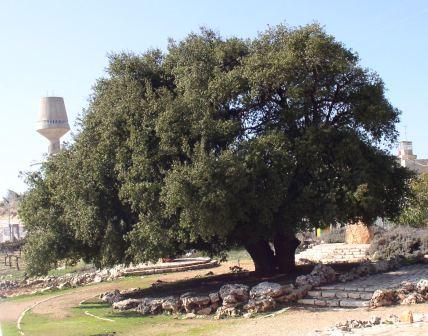
The setting, the campus of Yeshivat Har Etzion in Alon Shvut situated in the green hills between Jerusalem and Hebron is one of my favorite landscapes in Israel. I first visited the area in those euphoric weeks after the Six-Day-War in 1967. We reached the spot as the sky was turning the shades of pink, lavender and orange of summer sunsets and a cool breeze brought relief after a warm day of hiking and riding. Our tour leader told us the story of the "Lone Oak" (האלון הבודד) which stood as the last living symbol of the settlements destroyed by the Jordanians (and their defenders taken as prisoners) in the War of Independence. During the years between those wars  survivors and their children of the Etzion bloc settlements would meet on the Israeli side of the green line and look over at that remnant of their community. Alon Shvut means the Oak of Return.
The yeshiva, Har Etzion was founded by Rav Yehuda Amital Z"l  who passed away last week. The shiurim all began with mention of his passing and words in his memory.

Friday, February 26, 2010

Rehovot! What's new? What's old?


The view from the bus stop
Today, it's raining, hard. Just what we need after all the dry years we've had. Thank God, this is what we pray for. This storm, and it is a storm, is expected to last until Monday, comes just as we celebrate Purim. Kids won't be able to parade around in their costumes this year. I'm sure that's more than a little disappointing to many of them. 
Another event that won't be happening in Rehovot on Sunday is the kickoff of Rehovot's 120th birthday celebration. That has been postponed until next Friday morning. (Rehovot lovers abroad, that gives you a week to get here!) 
In honor of this milestone I am planning a few posts about Rehovot's history. This is not your Ari Ben Canaan (Exodus - Leon Uris, not Moshe Rabennus's - for those of you too young to remember) story. But it is interesting in other ways. 
Most people who think about it associate Rehovot's history with orange groves. The lament is that now the concrete is taking over the old orange groves. 
Well, before the orange groves, there was the idea. You know the one. Returning to Zion. 
Most folks attribute this to Theodore Herzl, who certainly helped organize the Zionists and put the idea out there. But 1890, was six years before he published his book The Jewish State (Der Judenstaat) and seven years before the first Zionist Congress. 
Jews returned to established Jewish cities, Jerusalem, Hebron, Tiberius and Safed over the years and by the 19th century there were communities in all these cities.  Petach Tikvah, was the first attempt to establish self supporting agricultural communities outside these cities in 1878. The first 9 of these settlements were all supported by the Baron Rothschild. 
Rehovot was the tenth settlement founded. It was started by middle class business people and merchants who got together money and bought 10,000 dunams of land from the Arabs of Khirbet Duran. 
Rehovot's founders (Epstein, Cohen, Kaplan and Gluskin)
Among the group were members of 'Hovevei Zion' (Lovers of Zion) from Warsaw. Hovevi Zion were religiously observant Jews who helped financially support the early settlements. The story goes that the group approached a woman for support and she asked, "If you are so excited about helping the settlements in Eretz Israel why are you still in Poland?" When they thought about it they realized she was right and decided to put themselves where their money was and organized 'Menucha v'Nahala' (the economic and social organization which actually bought the land and set the legal framework for running the settlement) and the rest is history. 
Oh, and the trademark orange groves were first planted in 1904. 

Tuesday, November 10, 2009

Do you believe in miracles?

This post, written by David, is dedicated to his father, Henry Fenster on his 85th birthday, may Hashem grant him many more years of health and happiness - biz hundret un zvantzig! 


I don't mean miracles like the parting of the Red Sea or extracting water from a rock. I'm talking about miracles performed by wonder working Hassidic rebbes who could bring children to the barren, heal the sick, protect the Jews from the goyish neighbors or travel in a sleigh from Rufschitz to Radomsk (a full day's journey) in the blink of an eye. 


Myself, I lean to a more Litvak-misnagdish (opponent of Hassidim) outlook. That is, I think every problem can be dealt with by sharp observation, cold analyses and maybe with a little pilpul (casuistry) for flavor. So I didn't believe in the wondrous power of Hassidic Rebbes -- until I heard this story from my father. 


It was 1944. My father a Jewish boy from the Jewish neighborhood of Logan in Philadelphia was nineteen years old. His father had passed away after a long illness and he had  graduated  Central High School and gone on to study business administration at university. After a year at college he joined the army and was sent to an engineering course. But then the army needed all their forces for the final fight against the Nazis. He was assigned to the infantry and trained to operate a field mortar. Before he shipped out to Europe, his mother (my Bubba Rose) went to the local Hassidic  Rebbe to ask for a blessing for her son. This was Rav Moshe Tzvi Twersky, scion of the great Tolne Hassidic dynasty founded by the first David Twersky around 200 years ago in the town of Tolnoya in the Ukraine. 


Bubba Rose was received in the Rebbe's shtible (Hassidic prayer room) by the Rebbe, who gave her 18 pennies “chai fenik”. The number 18 symbolizing 'chai' life. He told her to give the pennies to charity, that by virtue of the tzedaka (charity) and tefilla (prayer) her son would G-d willing return to her from the war. 
My father's unit landed in France in September, after the allied invasion on D-day. The first troops that landed  were well organized and had been together in training.  But the fighting was difficult and while they were pushing the the German army back to the German borderthey sustained over 70% casualties. My father's group were replacement troops sent to take over and make up for the men lost in the earlier battles.They participated in  battles in Normandy moved on into Alsace. Moving forward  meant digging a foxhole for shelter and shooting at the Germans and then moving to another place where another foxhole had to be dug and more firing. 


On October 14, near Luneville, his unit came out of a forest and advanced through a field towards a low hill. Suddenly the world exploded. They were caught in the open by a German artillary barrage. They  ran up the hill to the next place they would begin their digging in and my father felt what seemed like a sledgehammer blow to his lower back. He tried to keep up with the others but couldn't. The rest of the platoon continued advancing, leaving him there. This was not the IDF that 'never leaves the wounded in the field'. In WWII the army advanced and only later dealt with the wounded. There were no medics on the platoon level. He might have died in that field but by chance an armored vehicle was stuck in the mud and could not advance with the rest of the unit. As they extricated themselves from the quagmire they saw my father and took him in the vehicle to the next road. They left him on the road and moved on to join the advancing troops. Some time later, by chance, a partly disabled tank traveling back to the American lines for repairs found him and took him to the command bunker. He was shocked and worried that the officers would think he should have continued with the attack. Removing the heavy web belt he was wearing it became clear that he had lost a lot of blood. The belt absorbed the blood when he was hit by a cluster of shrapnel which lodged in his back near his spine. He reached down to take his helmet with him and the army surgeon who just happened to be in this forward command  bunker told him 'you won't be needing that' and started to work on him. The last thing my father remembered before going under the anesthetic was the surgeon saying that he had a million dollar wound, meaning it was serious enough to get him out of the war, but with luck would not leave him crippled for life. 


And so after two more operations in France he found himself being carried by German POWs onto a troop ship bound for the U.S. 


After recuperating in an army hospital for six months he was released. In July 1946 he married a Jewish girl from Philly (my mother Blossom Lichtenstein) and I was born five years later. 
Do I believe that the Tolne Rebbe miraculously watched over my father while his comrades were dying around him (and in the larger picture millions of Jews were being murdered in Europe)? 
Not really, but I also do not believe that it is the result of chance. I do believe in the divine destiny of the Jewish people, and the destiny of those Jews who survived WWII was to behold the rebirth of the Jewish Nation. 
I also believe that the prayers of a saintly Jew and a distraught Jewish mother opened a window in heaven through which divine providence would find my father and save him. And just maybe the Tolne Rebbe had a feeling this Jewish soldier would return from the war and raise a son who would go up to Israel to take part in the return of the people of Israel to its land. God would give him the privilege to see grandchildren and great grandchildren born in Israel who would close the circle on one Jewish family's sojourn in the exile. 
There is a footnote to this story. Recently I discovered that the present Tone Rebbe has a shtible in Bayit Vegan. I have heard a number of his sermons and lessons. He is an impressive speaker and is reported to be a wonder worker too.

Thursday, October 01, 2009

No such thing as coincidence!


Here's David* who is really happy to be holding today's amazing find - his Etrog with a gartel! The gartel is the "waistline" in the middle of the etrog giving it that hourglass figure. The term gartel comes from the Yiddish and means 'belt'. Hassidim wear a black gartel over their long jackets to signify the separation of their upper body where the heart and mind are and the lower body where the more animalistic functions reside.
 So when Hasidim look for an especially beautiful (mehudar) etrog they look for one with a gartel. They also had a tradition that the etrog with the gartel is reliably held to fulfill the requirement of growing on a tree that was not grafted. (Citrus trees like oranges are usually grafted to lemon trees because they are stronger.)

Now Hasidim and this tradition of finding the gloriously beautiful etrog with a waist have been around for about 350 years (give or take) but over the last few decades there have been some interesting archaeological finds. One of them was a picture on a mosaic floor in Hamat Gader ( southern Ramat Hagolan) dated around 230 CE or the time of the mishna. As you can see from this sketch (on the right) the etrog has a gartel! This shows that the etrog that our sages were talking about had a gartel.

Another mosaic found in the northern Negev and dated to the 6th century CE (the time of the gemara) shows two etrogim both with gartels.
It seems that there is even some scientific basis for the theory that the viroids which cause the gartel help prove that this species of etrog is genetically pure. See the Wikipedia here.

Happy Succot Everyone !!!!!

*A big thank you to David for helping with the background for this post!

Tuesday, April 21, 2009

"Anda" A play about the Eichmann trial

I went to see the play "Anda" written and directed by Hillel Mittelpunkt performed by the Beit Lessin Theatre. Here's the synopsis from Beit Lessin's website:
Israel, 1961. The eve of the Eichmann trial. Nochi, a bright young attorney on the prosecution team of the Eichmann trial, is flung into an unexpected conflict: Anda, a hospital nurse who survived Auschwitz, wants to testify at the trial, but has been rejected by Ben-Gurion’s political establishment. Nochi risks his career and his romantic involvement, and is torn between his desire to remain faithful to his principles and the pressure to bend to political dictates.
It is a powerful play which follows a fictional lawyer (Nochi) working in Gidon Hausner's prosecution department as he tries to help put together the case against Eichmann. He is periodically visited by a representative of the Mapai party who wants to influence the way the trial is handled. Specifically he wants to make sure that all the witnesses testifying have no affiliation with parties opposed to Mapai's agenda and especially no witnesses from Hungary who might stir up the issues related to Kastner. Anda comes to him having suffered through 'medical' experiments in block 10 of Aushwitz. The party man won't allow her testimony because he has a picture of her alongside Menachm Begin at the famous demonstration against taking reparations from Germany. The play explores the relationships between the European Jews who came to Palestine before the Holocaust, those born here, the Jews who came after the Holocaust and their children. Nochi is a child who was sent by his parents from Poland to Palestine at the last minute and grew up a kibbutz among sabras whose parents were kibbutzniks. Having no parents he was a yeled chutz, literally an 'outside child'. Nochi wants to be 'inside'. The play explores his relationship with the sabras in the form of his girlfriend and her father, with the people from 'there' like Anda and Nochi's own father who survived and now lives in Jerusalem struggling to come to terms with his survival and with his relationship with his son.

The characters represent forces that molded the collective
consciousness here in those early years. Ben-Gurion and Mapai were ruthless in their control. Some of this was bad indeed and we are still suffering from many of injustices and misjudgements of that period. But to be fair, had BG not been so heavy handed a lot of what was accomplished in those years might not have gotten done at all. Yisrael Eldad (one of the triumverate that headed the Lehi Fighters for the Freedom of Israel and father of Prof. Aryeh Eldad MK) used to say that if Menachem Begin had been Prime Minister instead of BG he would not have brought all those Jews to Israel to live in the ma'abarot (tent villages) in '48-49. He would have said to wait until things got a little better and we could offer them better conditions after all the suffering they've been through. There might very well be something to that.
The years before the Eichman trial were also the years when what we refer to today as the 'survivors' were just refugees, the remnants, the sheep who didn't get slaughtered. Nochi's world isn't interested in what happened to his father except to show that they were right, Jews belong here not there. And the Jews from there had to justify their survival. For the most part they kept quiet. The lucky ones managed to build a new life. The Eichmann trial was a turning point. It gave us all a chance to hear the stories. I believe that being able to focus on a trial and a punishment made it more legitimate to tell the story. This was not wallowing in self-pity but the survivors represented by their State prosecuting a perpetrator.

Grappling with our image of the Holocaust, the survivors, the role of the State of Israel and the role of the leaders in Eretz Yisrael before the state in relation to European Jewry is fascinating and complex. The play succeeds because it's not just about the past.
Many of the issues raised are as relevant to our identity as Israelis today as they were in 1961. Maybe even more so.

Related Posts with Thumbnails