Pages

Showing posts with label Zionism. Show all posts

Wednesday, August 07, 2013

Aliya Today

It's that time of year again. Nefesh B'Nefesh  has the Internet buzzing with live broadcasts of olim arriving early in the morning at Ben Gurion airport to the cheers of bleary eyed veterans who come there to meet them. Everyone is smiling and crying tears of joy.
Around our virtual campfire (Facebook) folks who came here pre-NBN reminisce about what it was  like 'before'. NBN has only been around for the last decade and has certainly revolutionized the immigration process. Many of the arrangements that took weeks of running around and filling out forms at different venues are now done at the airport or at central meeting places where the newbies are helped with opening bank accounts and signing up for health insurance, all of which make the process smoother, I'm sure.
Deep down under it all, all of us who choose Israel as our home arrive with an uplifting feeling of pride in the country mixed with a certain fear that we and the country will not live up to our expectations. Like every relationship we will become more realistic as we  go along. But those first impressions, those first heady days, those patting ourselves on the shoulder moments, those 'this is actually happening' feelings, they help us in our new role as immigrants.


My own first hours in Israel were just a few weeks after the Six Day War (which has become ancient history it seems).  My most vivid memory is of going with my friends to Tel Aviv where just about every balcony had an Israeli flag hanging out. The flags were in honor of the liberation of Jerusalem and in celebration of the survival of the State of Israel when just a few weeks before many had not been certain that this Zionist experiment would live out its second decade. That euphoria is sort of like the laughter after  a particularly scary roller coaster ride, you know the kind where you ride a loop that has you completely upside down and you doubt your sanity. When it's over your laughing from relief. Only this danger was real. And then it was miraculously over. (Or so we thought.)
Thank you Facebook friends for that trip down memory lane and thank you NBN for bringing home so many more American Jews.
 And to our new citizens:
!ברוכים הבאים

Wednesday, October 24, 2012

The Road to the 19th Knesset

Fellow Jerusalmite Esser Agorot has posted Haveil Havalim #382 - The Dual Elections Edition  in honor of the interest generated by the US elections and the Israel elections to be held Tuesday, January 22, 2013.
In Israel voters go behind a partition and choose a piece of paper with the letters of the party they wish to vote for and put that in an official envelope which they were given.  When all the votes are counted the seats in the Knesset are divided among the parties proportionally.  If your party received 10% of the votes then you would get 12 Knesset seats.
But how do you know which 12 party members get the seats?  Each party submits a list of 120 names of would-be Knesset members.  Then in the order they are on that list, they take seats in the Knesset so in our example names 1-12 on the list become Knesset members.  If one of these 12 should happen to resign (or falls as in \bottles of beer on the wall') then the 13th name takes her place.  So the order on the lists submitted to the election board really matters.
The Likud party has primaries and anyone who becomes a member of the party can vote (after 16 months membership).  My favorite candidate on the Likud's list is Tzipi Hotovely.  At age 33 she is finishing up her first term in the Knesset with an impressive record as the Chairwoman of the Knesset Committee on the Status of Women as well as  some other important committee membership.  She is firmly planted in the nationalist wing of the party of the current Prime Minister, Benjamin Netanyahu.  She is an eloquent proponent of many important family issues as well an advocate for strengthening Jewish  settlements all over the country.
This week I answered a call to help out in her office as the primaries in the Likud are November 22.  I got there and joined a group of young people in stuffing envelopes (!) with flyers extolling her achievements in the 18th Knesset to be sent out to Likud members who will be voting in the primaries.
That brought back memories of the last time I stuffed envelopes in an election campaign.  It was 1966 and Bobby Kennedy was running for Senator from New York.  I went to a midtown New York City office with some friends and we were put to work stuffing envelopes with campaign material.
It was in that same election that I spent a Friday afternoon with some high school friends accompanying the candidate from one department store parking lot to another supermarket parking lot where he took to the platform and made a short speech to the cheering crowd and shook hands with anyone willing to step up.  Our 'job' was to go on the bus and arrive at each venue before Kennedy and hand out campaign material and lead the cheering when he showed up.  We were a very enthusiastic group of teenagers and did our job with gusto.
I was having a good time and thinking how nifty democracy is.  Then someone from the campaign came on the bus and said that since we had done such a great job we were all invited to have a fish dinner with Kennedy his staff at a nearby restaurant.  Remember it was 1966 and Kennedy was a Catholic and it was Friday.  It would be very exciting and really something to remember.  But it was Friday and I had to get home to light Shabbat candles with my mother.   It was a sunny breezy fall afternoon and I remember as if it were this morning the thought that went through my head a I got off the bus and headed in the opposite direction to my family and home.  No matter how integrated I might feel, in the end I would always be an outsider.

Tuesday, October 04, 2011

Baruch Dayan Emet ~ Rabbi Hanan Porat

report here:  Rabbi Hanan Porat Passes Away 

Over the years that I have lived in Israel there has been no one person who I felt ideologically closer to than Rav Hanan Porat. His total commitment to Torah both in learning and teaching, his commitment to building up the land and people of Israel and his commitment to social justice will probably remain unequaled for a long time to come. It is not just that he said the right things, he lived them. And he expressed these ideas clearly and what I can only describe as gracefully.
His life was a blessing to our people and may the family find comfort in the rebuilding of Zion and Jerusalem.
יהי זכרו ברוך

Monday, May 09, 2011

Memorial Day

Eli Solomon H"YD
Tonight we went to Rehovot's memorial service held in the "Defender's Park" where there is a memorial wall on which the names of Rehovotites who gave their lives for our country are inscribed. It was an impressive and moving tribute lasting over an hour and attended by hundreds of our fellow citizens. A man who lost his father, a Holocaust survivor, at the age of 4 in 1953 (which makes him exactly my age) shared his feelings about growing up without a father and slowly piecing together his father's legacy. He visited the cemetery yearly with his mother and younger brother, but no one talked about his father. Over the years he began asking about him and learning more about him. Nowadays, he comes to the cemetery with his brother and their families, wives, children and grandchildren, over twenty member of the generations. They tell of the heroic efforts of the Holocaust survivor to get an education and become a teacher in the new State of Israel. They pass on that legacy now to the fourth generation.
Chaim (Chuck) Hornstein  HY"D
The Chief Rabbi of Rehovot, Rav Simcha Hacohen Kook spoke passionately of his participation in the War of Independence as a member of the Moriah brigade in Jerusalem where they tried to get through to the Jewish Quarter of the Old City and save the starving soldiers and residents. In the end they did not succeed and it took 20 years until Rav Kook was able to walk through the Mandlebaum gate, the house near the Eastern gates of th old city which he fled with his mother's family just before the Arabs blew it up killing Haganah defenders inside.Today he is, in addition to being chief Rabbi of Rehovot, the Rabbi of the newly rebuilt Hurva Synagogue in the Jewish Quarter of the Old City. He ended with an emphatic statement that Jerusalem must remain in our hands.
Most of the speakers expressed the wish for a speedy return home in good health for Gilad Shalit . The ceremony ended with Kaddish, El Maleh Rahamim and the singing of Hatikva.
Of course the ceremony started with the siren and the minute of silence when each of us reflects on our memories Among those I think about are, of course, my two friends 'from the old country' Eli and Chuck. May God avenge their blood.
Take a few moments to watch this clip. It graphically represents the bereavement we remember today. 

Monday, May 02, 2011

Honoring my father's memory

  Oz Avraham 'Finishing' a Tractate a few months ago
On the Shabbat before Passover my whole family all my children and grandchildren were in Mitzpe Ramon where we enjoyed each other's company and had our meals together in a local guest house, so that no one had to interrupt their Pesach preparations to cook and we didn't get any new chametz in any one's house. A lovely time was had by all. On Saturday night we all gathered together to mark my father's eleventh yahrtzeit (anniversary really, but it sounds so much more appropriate in Yiddish).
A traditional way of commemorating a yahrtzeit is by making a siyyum. studying a book or a tractate (of Talmud or Mishna) and gathering a minyan, reciting the last sentences of the book, teaching the meaning of that section and then reciting a formula in which the one who learned acknowledges that he has finished learning the section and promises to return to learn it once again. A special kaddish is recited.
David did a siyyum marking the culmination of his studying a tractate of Jerusalem Talmud. (Hopefully, he will write about that himself.)  
My first-born son and his first-born son (named after my father) learned a tractate of mishna together in time to do a siyyum too. So we had three generations participating. I felt particularly blessed that we were able to be together and remember my father. Both David and I spoke about him and I explained to my family the significance of the direct descendants of the deceased doing mitzvot especially (but of course not exclusively) on his yahrtzeit. (I explained it here but my kids don't really like reading in English.)
My father, Abraham Rich was the son of hard working Jewish immigrants, educated in New York City's publics schools and also in the traditional Jewish synagogue after school program, where he learned to read Hebrew for prayers and prepared for his bar mitzvah. Richmond Hill was a warm community, I know that because it was my first synagogue experience too, and my father's teacher, Mrs. Tombeck, taught me the ins and outs of shabbat prayers. I have been told he was known as 'honest Abe' and I know that he always believed in fairness and equality.
I remember my father only with a mustache
He and my mother were determined that their children would have a better Jewish education than they were able to get. To that end they looked for a school that would be suitable. They enlisted my mother's cousin, a Hebrew teacher and her husband a Rabbi to help find a school in the wilderness of Queens. (Yes, in the 50's orthodox Jews lived in Brooklyn.) I clearly remember sitting in the sunshine in my grandparents backyard in Richmond Hill when he came out calling 'who's got my girl?' with a braod smile on his face. My mother looked up and asked 'you found a school?' and he answered 'certainly looks like it!' And in the end, it did work out. (Along the way, there was a point when money was tight and someone suggested that maybe it wasn't necessary for a girl to have a day school education. My father told the man, if my daughter doesn't get the education, my son won't either. I have always more than appreciated that.)
This is the Saba my kids knew
A very early memory of mine is of my father putting on tfillin in the morning and standing at certain parts and then sitting down again. I remember asking about why he sometimes stood and sometimes sat. As we learned more, he learned more and as a family our observance became stronger. By the time my parents planned my brother's bar mitzvah keeping shabbat had become so important to them that instead of a party their invited the whole family to a hotel for the entire shabbat, so that no one would have to desecrate shabbat to come. I remember a long difficult phone conversation of his with a first cousin (of his) who wanted to come only to the service in the morning. He did not give in, she did not come. Everyone else did and it turned out to be a wonderful celebration.
My father became an active member of a number of shuls and was gabbai for a while. He was not the gabbai concerned with giving out the honors, he was the gabbai who had the key. You could rely on him to get there first and set things up. And of course, tell people to keep quiet during the service.

Savta & Saba
Another thing about him was his amazing patience. I don't think I every would have learned the multiplication tables if he hadn't made flashcards and taken the time to drill it into me, over and over and over again. I can also say that I did not learn long division in school. I learned it from him. And when my kids were being taught some new-fangled system for 'understanding' division I sat them down and said, "I'm not sure what they want you to do but let me teach you what Saba taught me." And I taught them the way he did. (My mother taught me to 'borrow' when subtracting. Most of my arthmetic skills I learned at home.)

I always felt secure in my home and with my family. Whether it was at the beach with the waves crashing around us or climbing the stairs to the crown of the Statue of Liberty I aways felt safe and secure when my father and mother were around. I am also grateful for the encouragement and understanding shown for my Zionist activities and later when I came to Israel. He was a very creative grandparent and overcame language difficulties to create a lovely relationship with our children.
May his memory be a blessing to us all.
יהי זכרו ברוך

Thursday, March 24, 2011

Thursday Challenge - GREEN

This photo was taken this summer in the Biriya forest in the Galilee.

The Jewish National Fund has been responsible for reforesting projects in Israel (and before that when Palestine was controlled by the Turks and then by British Mandate) making us the only country to finish off the 20th century with more trees growing than at the beginning of the century! 
Read more about the JNF here 
See more Thursday Challenge here.
Two more photos from that trip:
Birds in the Biriya Forest

Olive Trees in the Galilee 

Sunday, March 13, 2011

We are all Settlers!

So, we unplug ourselves for Shabbat and then after Havdala we realize that while we were happily enjoying ourselves with our children and grandchildren in Mitzpe Ramon a family was murdered in their beds in Itamar a settlement in the Shomron.
This morning, the first person I spoke to asked me how my Shabbat was.
I replied that Shabbat was lovely, until it ended and we heard the news.
He asked.
"Did you know them?"
Did I?
They were a couple in their mid-30's with six kids, none of them yet even in their teens, living in an isolated settlement with a fence around it keeping Shabbat, teaching Torah and building Eretz Israel.
Do I know them?

Sunday, February 13, 2011

25 Years Since Natan Sharansky Returned Home

Don't forget Haveil Havalim at The Rebbitzin's Husband!
So where were you on February 11, 1986? Me? I was living on a farm in the Golan Heights raising 5 kids and wondering how it would all work out. I had been living in Israel almost twenty years. I'd seen the euphoria of the aftermath of the Six Day War turn into the pessimistic depression of the aftermath of the Yom Kippur War. In 1975 we moved to Ramat Magshimim where all six of our kids were born.
The seventies ended with the upheaval caused by the Likud's Menachem Begin forming the first ever government not run by Labor. They made peace with Egypt and instituted far reaching economic changes. Our middlemost daughter (at the time our youngest) was a few months old when the whole moshav (or just about) went down to Yamit on Chanuka to express our solidarity with the settlers there on the eve of their eviction.   The twins were born the following year during the first Lebanon war which we called Shalom HaGalil (שלום הגליל) and it was meant to bring peace and quiet to the settlements along the northern border. By 1986 Peres (Labor again) was Prime Minister and Yitzhak Shamir was Foreign Minister. Inflation was rampant and we were in need of some good news.
In February 1986 the Kinar resort on the northeastern shore of the Kinnert was just being finished and had not yet opened for business. My older daughter (8 at the time) and her friend were taken down there one afternoon a few weeks after Sharansky came home and she was very excited when she came home because she and her friend had seen Natan and Avital walking along the beach. (She told me, they didn't go over to them because they knew that they needed to be alone together and it was a secret that they were there.) When she told me the story you could see that it was as if she had glimpsed the fairy princess and her prince charming. Such is the Zionist mythology. For us, this is our nobility.

An ironic footnote. Sharansky was released in exchange for two Russian spies handed over the US. It was about two and a half months after Jonathan Pollard and his wife were arrested. Pollard remains in jail in the US. 

Monday, November 15, 2010

Creativity in the face of challenge

Raise Your Spirits Theatre is a community theater group in Gush Etzion founded by Sharon Katz and Toby Klein Greenwald. The group puts on shows which involve many women in the planning, production and performance. Any profits are channeled toward helping victims of terror, families in need, emergency medical equipment and other needs.                                                                                   
"In 2001, amidst an atmosphere of grief and terror,a group of women in Gush Etzion joined together to the raise spirits of their community and all of Israel. Rather than succumb to the depression caused by daily terror attacks, they decided to start a project that would give them a positive outlet and something wonderful to look forward to. They decided to put on a show. The rest, as they say, is history. (from their website)"
Orthodox Jewish women don't have a lot outlets for their creativity if they are talented in the performing arts. But in the last generation there have been some serious efforts to encourage more opportunities. Emunah Teachers College in Jerusalem has a drama department and Orot Israel College in Elkana has a dance department. The graduates of these programs have been working in girls schools around the country setting up classes and in some cases departments where the girls of the religious Zionist community can learn, practice and perform.
The Raise Your Spirits group is different. This group is a group of everywomen or at least a nice cross-section of ages and interests. Some families even had three generations participating.
The book of Judges שופטים is the story of the early years after the Jews entered the Land of Israel and is about their struggle to conquer and rule the land. After Joshua's time there was a lack of central leadership and ups and downs regarding faith and unity among the people of Israel. Many see parallels to our situation today.
The Song of Devora is an upbeat story of charismatic leadership, faith and inspiration. The writers Toby Klein Greenwald and Yael Valier reach out and ignite our imaginations and the music by Mitch Clyman makes you want to get up and dance. Speaking of dance Sara Orenstein is an honors graduate of the Orot Israel dance and education program and did a fantastic job.
The performance is a patchwork of scenes which set the background to the story and then introduce each character center stage all leading to the great confrontation. The performers, some have professional training but most are just regular folks, carry this off beautifully. All through the show, besides performing admirably they show us that they are not just individual performers but a cohesive unit and most of all they seem to be having a really good time.
After all the finales we were asked to stand for Hatikvah and Ani Ma'amin. The auditorium at the community center in Gush Etzion became a very intimate place as the dozens of players and production helpers who were on stage face the scores of women in the audience and sang together. In those moments you could feel the unity and faith that is the common denominator for all of us there. It was very very special and I hope to see more of these moments.

Monday, September 20, 2010

After Yom Kippur come the Memorials

Yom Kippur is first and foremost a religious experience coming after an intense week of celebration and soul searching. The season invites us to keep in touch with friends and family sometimes serving as a welcome reason to renew and upgrade our relationships. The weeks leading up to Rosh Hashana and especially the week between the holiday and the fast are filled (in Israel at least) with many many opportunities to hear shiurim (lectures) which can often help us in our journey towards Yom Kippur. Yom Kippur itself is a very intense and often emotional day. And when we finally hear that one last long shofar blast and sing 'Next Year in Jerusalem' we are ready to move on to our next mitzvah, building the succa. 
But it doesn't really happen that way. Not here, not today, not anymore. 
Thirty-seven years ago on Yom Kippur the State of Israel and her mighty army was surprised and attacked and we came so close to losing everything. As the years go by and more is revealed we come to realize how precarious the situation was. Even more so than we realized back then. Over 2,000 men were killed in the official war and many  more in the long nerve-wracking  months after the cease-fires. 
So that day after Yom Kippur is the official memorial day for that war and the military cemeteries fill up for ceremonies and services both public and private. 
And so I would like to pause to remember two friends of mine who gave their lives for our country. 
These men grew up in the New York City and made the choice to come and live here in Israel. I met them when I was still in high school and we were all members of the Zionist youth movement Betar. We spent many Sundays together at meetings which included besides talking Zionism also much singing and often dancing. Some of us still get nostalgic at a blog we set up "Betarim in North America" where we post old photos and reminisce. (What follows are not biographies but my feelings.) 

Next Friday, the 16th of Tishrei is the yahrtzeit of Chaim (Hornstein) Haran הי"ד (Hashem yikom damo, may G-d avenge his blood) who participated in the battle in which the Syrian army overtook the "country's eyes" the post atop Mt. Hermon. He was a member of the Golani Brigade's elite scout unit and was killed by Syrian air fire in the attempt to retake the Hermon.
Chuck (his 'English' name was Charles) was a very bright child. His parents had divorced when he was around two years old and it couldn't have been easy for him. He was close to some of the leaders of Betar and they tried to encourage him to stay in school and fulfill his potential. He came to Israel after the Six-Day-War but he was still too young then to join the army yet. He went back to the US and eventually came back and joined Golani. I wasn't in touch with him when he came back then but I remember vaguely knowing he was in the country. 
 He was 23 years old when he was killed. He didn't have the chance to marry and have a family.At first we cried because we suffered a loss. Now, as I get older and Chuck stays the smiling good looking teenager I remember I am overcome by a different kind of grief. It is a mourning for those he didn't get a chance to leave behind. Instead of time healing I feel I truly grieve more for him as the years go by. 


Eli Michael Solomon הי"ד was one of the first people I met in Betar. I was still in high school then. He is the on the left in this picture playing the drum. Eli was the kind of guy who made sure that everyone was involved in the activity. It wasn't enough for him that he was having a good time, everyone had to be having a good time. People always felt comfortable around Eli.
Eli went off to join the volunteers the week before the Six-Day-War and we all sat around at the airport singing at the top of our lungs while he waited to board the flight. Rena, who he married the following summer, slept over at my house that night because we lived close to the airport. I left a few weeks later for Israel and the next time the three of us were together was in 1970 when Rena and Eli came to live in Jerusalem. I had made many friends in Jerusalem by then but it was so special to have friends who knew me from 'the old country'. It was almost like having family.
I always felt at home with both of them and when their first daughter was born I was happy to babysit. Its odd what scenes come to mind when I think back to those days. I remember visiting them once and finding Eli relaxing, drinking a beer and watching the 1972 Olympics on TV. We all had a good laugh at that scene of him being so settled down. A few days later the whole world seemed very different as the jolly Olympics turned into a bloodbath of terror and death, and then the show just went on. The next time we were together we remarked about that.
When David and I got married Eli was doing basic training in the army. Rena had taken her daughter to New York and I was hoping that at least Eli would be able to come to the wedding. In the end he came to visit us a few days after because they hadn't approved the leave. I was glad to see him but really disappointed that he had not been with us.
Eli and Rena moved to Amatzya (near Kiryat Gat) and visiting became much more difficult. Not only was it far away but coordinating a visit was really difficult because at the time we didn't even have a phone. It's hard to imagine nowadays. When Eli was killed our friends had to come to our house to tell us and then we went to neighbors to call to find out the details of the funeral.
There are milestones and turning points in our lives when we gain a insight or gain experience, Eli's death taught me about a sadness I hadn't really known up close before.
We have all grown older and seen some bad times but also many good times. We have put on weight and turned grey. I look at my friends each year when we gather at Eli's grave (Rosh Chodesh Kislev or as near as possible) and see them as they were then but also as they are now. I guess you could say that Eli is there making sure  we all stay in touch. Eli remains for me the cheerful and optimistic young man who rode the subways with me in New York. How I wish I could see him all grey or even bald.

יהי זכרם ברוך
May their memories be blessed be a blessing  to us.

Saturday, September 04, 2010

Echoes of a Shofar


It's been a difficult week for us here in Israel. We are witnessing a deterioration of our security, once again in the name of 'peace talks'. The murder of four Beit Chaggai residents last week looms like black cloud over my Rosh Hashana preparations. Seven new orphans, a young widowed bride, a volunteer emergency responder who responded to find his own wife the victim of this  murder don't make it easy to get on with your regular daily agenda.
This video comes to remind us of where we are coming from in our struggle for Jewish sovereignty and is a tribute to brave men and good Jews. In the spirit of the shofar's call for introspection and repentance let us resolve to do what we can to come closer to redemption this year.


L' Shana Tova Techateivu v'Techateimu לשנה טובה תכתבו ותחתמו
May you all be inscribed in the book of life. 
Amen!  

Monday, August 16, 2010

Making the Desert Bloom: The MOVIE!


The term "Zionism" has been taking a beating even here in Israel. Media and opinion-makers have been informing us that we are now post-Zionism. That may account for some of the indifference to the injustice and self-defeating nature of the 'disengagement' from Gush Katif. There is no denying that in some circles the connection between putting down roots dunam by dunam, plant by plant, tree by tree is seen as an outmoded concept of neo-colonialism. The word 'settlers' has become a pejorative for some.
Watch this video, see what Zionism without quotes can be.
See that Zionism is every bit as relevant today as it was a hundred years ago.
Zionism is alive and thriving!
Yasher koach to Kerem Ramon!

Sunday, July 18, 2010

What I've been up to...

I posted about some Kosher Nostalgia over at Batya's blog.
I also attended one of the 5 days this year devoted to bible study at the Herzog College in Gush Etzion.
All day long there are 7 different lectures going on simultaneously and the event is attended by over a thousand (my estimate from the size of the lecture halls I saw) people daily. It is an amazing experience. The quality of the lectures I chose this year was excellent. The day I was there they also had two more lecture choices every hour in English.
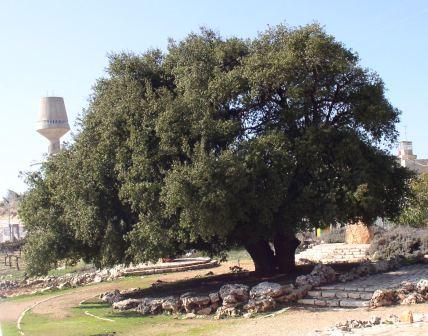
The setting, the campus of Yeshivat Har Etzion in Alon Shvut situated in the green hills between Jerusalem and Hebron is one of my favorite landscapes in Israel. I first visited the area in those euphoric weeks after the Six-Day-War in 1967. We reached the spot as the sky was turning the shades of pink, lavender and orange of summer sunsets and a cool breeze brought relief after a warm day of hiking and riding. Our tour leader told us the story of the "Lone Oak" (האלון הבודד) which stood as the last living symbol of the settlements destroyed by the Jordanians (and their defenders taken as prisoners) in the War of Independence. During the years between those wars  survivors and their children of the Etzion bloc settlements would meet on the Israeli side of the green line and look over at that remnant of their community. Alon Shvut means the Oak of Return.
The yeshiva, Har Etzion was founded by Rav Yehuda Amital Z"l  who passed away last week. The shiurim all began with mention of his passing and words in his memory.

Sunday, July 11, 2010

Remember Gush Katif

Rosh Chodesh Av 5770

Tonight marks the beginning of the month of Av and our mourning for the destruction of the temple goes into high gear. This time of year we mark anniversaries which remind us of many tragedies which have befallen the Jewish people over the millennia. The root of the tragedy is in the story of 12 men sent by Moses to report on the conditions in the promised land. recounted in Bamidbar (Numbers) 13. Ten of them disparaged the land and reported that it would be difficult to conquer. Only Joshua and Calev went against the majority and tried to convince the people to believe in their strength and G-d's promise. But the people cried bitterly and despaired. Because they despaired and cried when it was not necessary (because G-d would have been with them and helped them conquer the land had they reported positively) they had to wait 40 years to enter the land. But also G-d said because they cried for no reason on that 9th of Av, I will give them good reason to cry on the 9th of Av throughout the generations. So it was on that date that first and second temples were destroyed. The mishna also mentions other tragedies such as the death of Bar Kochba and the fall of the city of Beitar. Over the years other things that happened around this date were decrees associated with the inquisition, the beginning of World War I and major actions in the Warsaw ghetto. In 2005 Arik Sharon originally intended to begin the evacuation and destruction of Gush Katif on that day. (Of course they weren't looking at the Jewish calendar when they picked the day and when they realized the significance they moved the date a few days off. Who did they think they were fooling?)
Five years later...
Leaving Gaza did bring us any closer to peace with the "Palestinians" not in Gaza or anywhere else. 
Leaving Gaza did not prevent the Hamas from taking over Gaza. 
Leaving Gaza did not prevent the shelling of the Western Negev and the cities of Sderot, Netivot, and Ashkelon. 
Leaving Gaza did not make it safer for our soldiers anywhere. 
Leaving Gaza did not prevent the kidnapping of Gilad Shalit. 
Leaving Gaza did not prevent another war (Cast Lead).
Five years later the former residents of Gush Katif are still trying to recover from the trauma. Slowly they are rebuilding their lives and founding new settlements. 

Some people say that the struggle against the evil decree failed because not enough Israeli citizens were against it. If that is so, we have only proven that when we don't show our faith we end up repeatedly crying.  
~~~~~~~~~~~~~
Thursday, 15 July, from 19:30-21:15, at the OU Center, Jerusalem.
(22 Keren Hayesod Street):
A program especially created for English speakers will take place next week, Thursday, 15 July, from 19:30-21:15, at the OU Center, Jerusalem. It will feature speakers Dror Vanunu, International Coordinator of the Gush Katif Fund and Rachel Saperstein, Director of Operation Dignity. An exclusive film produced by the Gush Katif Committee will be shown. This is one of 70 such events taking place across the country. 
For more about marking the anniversary go here

Friday, June 25, 2010

More blooming in the desert!

On Tuesday we went down to Mitzpe Ramon for the inaugural planting of "Kerem Ramon" (Ramon Vinyard).  The weather was unusually hot and dry and the sands of the Sahara were relocating to the Negev. It was one of those middle-east chamsin days, so called because of the Egyptian folklore about there being 50 days like this a year. (Hat tip to עברית שפה קשה). Fortunately for us there are usually a lot fewer than 50 days like this in Israel. 
In this age of post-Zionism it was refreshing to be part of this expression of faith in this dream of a Jewish state. Planting is the ultimate expression of faith. It would seem to me that there can be no atheists in a vineyard. A farmer sows his seeds and from that moment until the harvest those seeds are affected by so many environmental factors that even our modern technological agribusiness wisdom is incapable of controlling all of them. No, it takes the planter and the massive help of God to bring those seedlings that we planted to maturity and fruition. (See David's comment below) So it was fitting that this ceremony was begun with words of Torah by Rabbi Tzvi Kostiner of Mitzpe Ramon's Yeshivat Midbara KaEden. The Yeshiva is at the heart of a vibrant young community of families who make their homes in Mitzpe Ramon. Most of the men were once students at the Yeshiva. 14 of those families joined together to form an agricultural cooperative and bought the land where we planted the vineyard. They plan to use half the profits earned from the vineyard to further educational and social projects in Mitzpe Ramon. In addition they hope to be able to employ Mitzpe residents at the vineyard and the winery which they hope they will be able to build to make wine from the grapes.
I am so proud of this amazing initiative and I add my prayers to theirs for the success of this endeavor. 
שִׁיר הַמַּעֲלוֹת
בְּשׁוּב יְהוָה, אֶת-שִׁיבַת צִיּוֹן--    הָיִינוּ, כְּחֹלְמִים.
  אָז יִמָּלֵא שְׂחוֹק, פִּינוּ--    וּלְשׁוֹנֵנוּ רִנָּה
אָז, יֹאמְרוּ בַגּוֹיִם--    הִגְדִּיל יְהוָה, לַעֲשׂוֹת עִם-אֵלֶּה.
  הִגְדִּיל יְהוָה, לַעֲשׂוֹת עִמָּנוּ--    הָיִינוּ שְׂמֵחִים.
  שׁוּבָה יְהוָה, אֶת-שבותנו (שְׁבִיתֵנוּ)--    כַּאֲפִיקִים בַּנֶּגֶב.
  הַזֹּרְעִים בְּדִמְעָה--    בְּרִנָּה יִקְצֹרוּ.
 הָלוֹךְ יֵלֵךְ, וּבָכֹה--    נֹשֵׂא מֶשֶׁךְ-הַזָּרַע:
בֹּא-יָבֹא בְרִנָּה--    נֹשֵׂא, אֲלֻמֹּתָיו.

A song of ascents. When God brought back the exiles of Zion we were like dreamers!
Then our mouths filled with laughter and our tongues with joyful songs. 
Then it was said among the nation: 
"God has done great things for them!" 
God did do great things for us and we rejoiced. 
Return our exiles Lord, like rushing streams in the dry desert. 
May those who sowed in tears reap in joy. 
May one who goes out weeping, carrying a bag of seed return with songs of joy, carrying his sheaves!

Friday, May 28, 2010

The Emanuel Family's Bar Mitzvah - Not your father's "Today I am a fountain pen"

From the website of the Western Wall Foundation: Celebrate at the Wall 
How much does it cost to make a Bar Mitzvah at the Western Wall?
 The Western Wall belongs to the entire Jewish people and the entrance is free. There are independent people who come to the Wall and offer to assist families in organizing their event for a price. 


The Western Wall Heritage Foundation provides volunteers who will help you with all aspects of your Bar Mitzvah at the Wall.
The Emanuel family from Chicago is here in Israel to mark the occasion of their son Zach's Bar Mitzvah. Dozens of boys and their families do this every week and it really shouldn't cause so much of a stir, but some people didn't like that idea and heckled the group as they visited the Western Wall yesterday. (see here) I really don't think that they acted appropriately or that their action was particularly effective. Instead of focusing on the real issues this just calls attention to the protesters.

But still, what's wrong with this picture? Why does this situation make me feel so uncomfortable?
The Western Wall isn't an impressive building. It's what's left of the supporting foundation of the impressive temple which was destroyed almost 2,000 years ago.  The Jewish people spent all those years in the diaspora mourning the destruction, of course, but also emphasizing the centrality of that temple and the land of Israel and never giving up hope of returning and rebuilding Jerusalem. It's right there in our prayers. Three times a day. Every day. In 1967 the Jews who returned to the land regained control of the area and so for the first time since the destruction of the temple 'entrance is free'. By taking advantage of this freedom though, I would say that you have to acknowledge that this a step closer to returning and rebuilding.
Forty-three years and we are already taking it for granted that Rahm Emanuel and his 13 year old son can come 'make a bar mitzvah' at the Western Wall. Actually you don't 'make' a bar mitzvah. You become a 'bar mitzva'. It's a status, at 13 (12 for girls) you become religiously responsible for you actions and are obligated in all the commandments. That's pretty serious stuff.
Did Rahm Emanuel actually shed a tear at the Kotel? It's hard to tell from the pictures. Maybe my discomfort with this whole brouhaha is the feeling that sometimes the Western Wall seems like Disneyland, more magical make-believe than spiritual commitment. 

Wednesday, April 21, 2010

Making Deserts Bloom and Other Miracles

Singing Hatikvah with my children when they were young filled me with awe. Could this be me? Monday night I stood and sang the national anthem with my grandchildren!!! What an honor and privilege! Baruch Hashem!
For some statistics on Israel's population today see: 
here.


David and I drove down to Mitzpe Ramon to celebrate Independence Day with our children and grandchildren there. The super-rainy winter left the desert greener than usual and we took full advantage of the phenomenon. Here's what the roadside looked like. 

We arrived in Mitzpe Ramon just in time for the ceremony marking the transition from Memorial Day (Yom Hazikaron - see below) to Yom Haatzmaut (Independence Day). It was nicely done beginning with words by the Rav Tzvi Kostiner of Midbara Kaeden Yeshiva. Tehilim were read and there was a presentation about bereaved families and fallen soldiers. After the flag was raised to full mast we had presentations by the local music ensemble and the kindergarten children danced for us with flags and balloons. Then we sang Hatikva and went inside for a festive evening prayer. This year there were two separate venues for the ma'ariv, one at the Yeshiva and one in the community synagogue in the local elementary school. I am overwhelmed by the realization that I live in a time and place where we are thanking Hashem for a miracle that we are witnessing. I find it hard to put into words. 
Then, as with so many other Jewish holidays, went home to show our appreciation for the miracles that G-d sends us by eating
In the morning, after the shaharit (morning) service which included Hallel and a leisurely breakfast (in commemoration of  Sundays in golus/New York :)) we organized ourselves for a trip to the local swimmin' hole. Because of the generous rainfall this year (a blessing from Hashem, part of which we witnessed on the very rainy Shabbat HaGadol just before Pesach) there is a rather large natural pool of water right down in the Ramon Crater about 10 minutes drive (can also be done by hike or bike) from Mitzpe Ramon. It was a bright sunny day and my son brought a beach umbrella and mat so we were able to spend over two hours at this amazing attraction (unshielded from the sun you really want to leave after about 10 minutes). So sunscreened and with lots of good spirits we enjoyed our 'beach' outing. We even had ices! 
Meanwhile, back at the ranch, busy family members were setting up the traditional Bar-B-Q without which no Yom Haatzmaut is complete. We were joined by many friends and neighbors of my children including families who had once lived in Mitzpe and returned to visit. Everyone was in a good mood although I don't know where the kids get all their energy. 


David and I still had one more stop we wanted to make on our celebratory itinerary. We wanted to see the new site of the Atzmona (the pre-army Torah learning and training program for religious boys which was uprooted from Gush Katif) community where one of our sons teaches and plans to live. So off to the western Negev we went. 
 
And then we went to have coffee before the drive home and say hello to the rest of our grandchildren in the temporary housing of this community in Yated. 


Happy, tired and feeling really blessed we returned home to Rehovot. 
What a week!


Yom Hazikaron - Memorial Day

Each year on the day before Israelis celebrate their independence a day is set aside to honor the memory of those who died in Israel's wars, in the underground forces which fought for our independence and civilians murdered by terrorists. 
At exactly 8 PM on that evening a siren is sounded and Israelis all over the country stop what they are doing and stand silently wherever they are. In every city there are ceremonies that begin a few minutes before the siren. But even those who are not there listening to the speeches participate in the memorial. Wherever we are, we stop and focus on the men and women who were killed because Jews returned to Eretz Israel and are building a state. 
At 11 AM the next morning the scene is repeated in the military cemeteries  and once again Israelis on the street, in their offices and shops devote a moment to reflect on what it takes to ensure that we can go about our daily lives in this country. 
The siren rips through our consciousness forcing introspection. For those moments there is no debate and no argument only unity, meditation and introspection. 
Some find this memorial inappropriate and ill timed. They say that going from the sadness of the memorial day to the celebration of Independence Day is too harsh a contrast. They don't like the sirens. 
I have heard the sirens compared to the call of the shofar. I like the analogy. The shofar was used in times of danger or war to rally the people and call them to action. In the month of Elul and on Rosh Hashana the shofar helps us take stock of ourselves and waken our desire repent and do better. I feel shofar as well as hear it and on those memorial days I have the same feeling when the siren sounds. On Rosh Hashana it is between me as an individual and God. On the memorial days there is an element of unity and common destiny with Israel and our people. 
I have a friend who says that she doesn't like the transition from the mourning Yom Hazikaron (memorial day) to the celebrating on Yom Haatzmaut (independence day). I agree that it is not easy. But, I would rather have it this way than pretend that we can separate the two factors in our history. We did not achieve our independence without a price and we can not ignore that. By the same token we have to recognize the miracle of the State of Israel and the progress we have made over the past 62 years. So we need a day for mourning and remembering and a day for giving thanks and celebrating and we need to make the connection. That's life. 

Friday, February 26, 2010

Rehovot! What's new? What's old?


The view from the bus stop
Today, it's raining, hard. Just what we need after all the dry years we've had. Thank God, this is what we pray for. This storm, and it is a storm, is expected to last until Monday, comes just as we celebrate Purim. Kids won't be able to parade around in their costumes this year. I'm sure that's more than a little disappointing to many of them. 
Another event that won't be happening in Rehovot on Sunday is the kickoff of Rehovot's 120th birthday celebration. That has been postponed until next Friday morning. (Rehovot lovers abroad, that gives you a week to get here!) 
In honor of this milestone I am planning a few posts about Rehovot's history. This is not your Ari Ben Canaan (Exodus - Leon Uris, not Moshe Rabennus's - for those of you too young to remember) story. But it is interesting in other ways. 
Most people who think about it associate Rehovot's history with orange groves. The lament is that now the concrete is taking over the old orange groves. 
Well, before the orange groves, there was the idea. You know the one. Returning to Zion. 
Most folks attribute this to Theodore Herzl, who certainly helped organize the Zionists and put the idea out there. But 1890, was six years before he published his book The Jewish State (Der Judenstaat) and seven years before the first Zionist Congress. 
Jews returned to established Jewish cities, Jerusalem, Hebron, Tiberius and Safed over the years and by the 19th century there were communities in all these cities.  Petach Tikvah, was the first attempt to establish self supporting agricultural communities outside these cities in 1878. The first 9 of these settlements were all supported by the Baron Rothschild. 
Rehovot was the tenth settlement founded. It was started by middle class business people and merchants who got together money and bought 10,000 dunams of land from the Arabs of Khirbet Duran. 
Rehovot's founders (Epstein, Cohen, Kaplan and Gluskin)
Among the group were members of 'Hovevei Zion' (Lovers of Zion) from Warsaw. Hovevi Zion were religiously observant Jews who helped financially support the early settlements. The story goes that the group approached a woman for support and she asked, "If you are so excited about helping the settlements in Eretz Israel why are you still in Poland?" When they thought about it they realized she was right and decided to put themselves where their money was and organized 'Menucha v'Nahala' (the economic and social organization which actually bought the land and set the legal framework for running the settlement) and the rest is history. 
Oh, and the trademark orange groves were first planted in 1904. 

Tuesday, November 17, 2009

IDF is for defending Jews not exiling them!

Thank you  toTzippi Hotovely and Aryeh Eldad  for proposing a law that would squarely put the responsibility for police actions on the police. Yes, they want to the army's job to be defense and leave throwing Jews out of their homes* to the police. 
*This should not be taken as an endorsement of throwing Jews out of their homes. 
Related Posts with Thumbnails