See a video of the Palestine women's soccer team first home game here:
Thursday, October 29, 2009
Tuesday, October 27, 2009
Not just about women
Mimi (probably with some help from Alice) has given us an amazing Kosher Cooking Carnival post. Check it out!
Now it's official!
It's not legal to force women to sit in the back of the bus!
Now it remains to be seen if this brings change.
Now it's official!
It's not legal to force women to sit in the back of the bus!
Now it remains to be seen if this brings change.
Monday, October 26, 2009
The People's Army
Haveil Havalim is here
Once upon a time, not so long ago, the Israel Defense Force
צבא הגנה לישראל צה"ל
was known as the great equalizer. Everyone, or almost everyone, was conscripted and the experience of living together, fighting together and possibly dying together made comrades out of an unlikely collection of immigrants and natives alike. Everyone knew who the enemy was and the purpose of the army was to fight the enemy and protect the country. Tzahal (IDF) was called 'the people's army' because aside for almost universal conscription, soldiers were also called up for reserve duty yearly (many times even more frequently) until they were well into middle age.
The summer of 2005 brought a major change in the concept of the IDF. Instead of fighting a common enemy, Arik Sharon and his government used the IDF turn Jewish citizens out of their homes.in Gush Katif and the Shomron. A democratic country has the right to enforce laws but the body which is charged with enforcing those laws are the police. Members of the police force choose their career and can resign for personal or professional reasons. Not so, the conscripted soldier. Many soldiers serving during the disengagement were put in an intolerable position. There was talk of refusing to carry out orders and a few incidents where this happened.
Apart from strongly opposing the disengagement itself I believe that this cynical and sinister use of the army is anti-democratic and harmful to our society. There has been a lot of talk lately of regrets and apologies and attempts to 'make it up' to the people displaced by the disengagement. Along with that we should do ourselves a favor and make sure that our soldiers never have to face the decision of whether to follow an order to turn a Jew out of his home. This should be a major issue brought before the Knesset and legally prohibited.
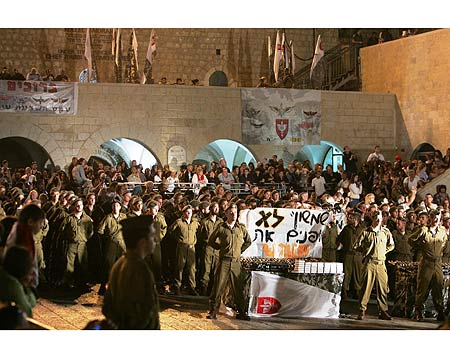
Last Thursday night two soldiers registered their opposition to the IDF's continued use of soldiers in carrying out government policy against Jewish revenants (settlers who return to their homes) in Chomesh in the Shomron. I agree with their sentiments wholeheartedly but I believe that the army can not be used as a forum for political ideology. I do not want the security of our country to depend upon the willingness of individual soldiers to carry out orders. It just can't work that way. Those soldiers will have to face the consequences of their actions.
The rest of us will have to sort this out and fast. Now is the time to demand of our democratic system to take this debate out of the military once and for all before it leads to further deterioration of the consensus.
Once upon a time, not so long ago, the Israel Defense Force
צבא הגנה לישראל צה"ל
was known as the great equalizer. Everyone, or almost everyone, was conscripted and the experience of living together, fighting together and possibly dying together made comrades out of an unlikely collection of immigrants and natives alike. Everyone knew who the enemy was and the purpose of the army was to fight the enemy and protect the country. Tzahal (IDF) was called 'the people's army' because aside for almost universal conscription, soldiers were also called up for reserve duty yearly (many times even more frequently) until they were well into middle age.
The summer of 2005 brought a major change in the concept of the IDF. Instead of fighting a common enemy, Arik Sharon and his government used the IDF turn Jewish citizens out of their homes.in Gush Katif and the Shomron. A democratic country has the right to enforce laws but the body which is charged with enforcing those laws are the police. Members of the police force choose their career and can resign for personal or professional reasons. Not so, the conscripted soldier. Many soldiers serving during the disengagement were put in an intolerable position. There was talk of refusing to carry out orders and a few incidents where this happened.
Apart from strongly opposing the disengagement itself I believe that this cynical and sinister use of the army is anti-democratic and harmful to our society. There has been a lot of talk lately of regrets and apologies and attempts to 'make it up' to the people displaced by the disengagement. Along with that we should do ourselves a favor and make sure that our soldiers never have to face the decision of whether to follow an order to turn a Jew out of his home. This should be a major issue brought before the Knesset and legally prohibited.
Last Thursday night two soldiers registered their opposition to the IDF's continued use of soldiers in carrying out government policy against Jewish revenants (settlers who return to their homes) in Chomesh in the Shomron. I agree with their sentiments wholeheartedly but I believe that the army can not be used as a forum for political ideology. I do not want the security of our country to depend upon the willingness of individual soldiers to carry out orders. It just can't work that way. Those soldiers will have to face the consequences of their actions.
The rest of us will have to sort this out and fast. Now is the time to demand of our democratic system to take this debate out of the military once and for all before it leads to further deterioration of the consensus.
Monday, October 19, 2009
What's In A Name?
Now that Risa has graciously invited me to be a guest on her blog (please do NOT call me IsraDad) I would like to share something about our name.
In the beginning of parshat Noach G-d says to Noah "You shall make an ark...A 'tzohar' you shall make for the ark" What is the 'tzohar'? The Koren bible translates 'a window' while Hertz tranlates 'a light'. This is a modern expression of the dispute Rashi brings from Midrash Rabbah where R' Abba bar Kahana says 'it is a window' and R' Levi says 'it is a precious stone'. R' Yochanan in the Gemara says 'the holy one - blessed is he said to Noah 'set precious stones in the ark so that they will give light as if it were the afternoon (tzoharaim צהרים)
How did I adopt the name Tzohar? Almost forty years ago I was a soldier named David Fenster serving in the Jordan Valley. It was shabbat parshat Noah and I was talking with a friend about family, where we were from etc. I happened to mention my mother's maiden name was Lichtenstein.
He said, "wait a minute! I want to show you something from the parasha."
He showed me the Rashi that said: tzohar - some say a window and some say a stone emitting light.
I said "so?"
He said, "don't you get it? In Yiddish, Fenster is a window and Lichtenstein is a stone that gives off light. You are the Tzohar!!
From that time I began thinking of myself as David Tzohar. When Risa and I decided to get married we decided to take a Hebrew name. I suggested Tzohar and she agreed. (Maybe because Tzohar happens to be the acronym for TZionut HaRevisionistit - Revisionist Zionism, the political movement founded by Ze'ev Jabotinsky - and Risa was a member of Betar, the Revisionist youth movement.*)
I think that I can suggest an interpretation of Tzohar that is a synthesis of the two meanings, a window or a stone which gives light. Modern optic technology has created a scope that amplifies ambient light at night enabling the user to see almost as if it were daytime. This technology was successfully used by the IDF for night time operations in Lebanon and Gaza. During the Flood the world was shrouded in darkness, the light of the sun and the moon could not penetrate. G-d was saying to Noah 'make a special window out of precious stones that will amplify what little light there is left in your world so that you can see enough to tell day from night"
The great Hassidic master, the Noam Elimelech (R' Elimelech of Lizhansk) said that the Tzohar is a metaphor for our lives. We must open a window to our souls and let in the light that G-d has created in His world. But, in times of darkness we must seek out that gem, that spark of holiness and divinity and use it to generate a light that comes from within.
*Although I did make the connection it was NOT a factor in the decision (Risa)
In the beginning of parshat Noach G-d says to Noah "You shall make an ark...A 'tzohar' you shall make for the ark" What is the 'tzohar'? The Koren bible translates 'a window' while Hertz tranlates 'a light'. This is a modern expression of the dispute Rashi brings from Midrash Rabbah where R' Abba bar Kahana says 'it is a window' and R' Levi says 'it is a precious stone'. R' Yochanan in the Gemara says 'the holy one - blessed is he said to Noah 'set precious stones in the ark so that they will give light as if it were the afternoon (tzoharaim צהרים)
How did I adopt the name Tzohar? Almost forty years ago I was a soldier named David Fenster serving in the Jordan Valley. It was shabbat parshat Noah and I was talking with a friend about family, where we were from etc. I happened to mention my mother's maiden name was Lichtenstein.
He said, "wait a minute! I want to show you something from the parasha."
He showed me the Rashi that said: tzohar - some say a window and some say a stone emitting light.
I said "so?"
He said, "don't you get it? In Yiddish, Fenster is a window and Lichtenstein is a stone that gives off light. You are the Tzohar!!
From that time I began thinking of myself as David Tzohar. When Risa and I decided to get married we decided to take a Hebrew name. I suggested Tzohar and she agreed. (Maybe because Tzohar happens to be the acronym for TZionut HaRevisionistit - Revisionist Zionism, the political movement founded by Ze'ev Jabotinsky - and Risa was a member of Betar, the Revisionist youth movement.*)
I think that I can suggest an interpretation of Tzohar that is a synthesis of the two meanings, a window or a stone which gives light. Modern optic technology has created a scope that amplifies ambient light at night enabling the user to see almost as if it were daytime. This technology was successfully used by the IDF for night time operations in Lebanon and Gaza. During the Flood the world was shrouded in darkness, the light of the sun and the moon could not penetrate. G-d was saying to Noah 'make a special window out of precious stones that will amplify what little light there is left in your world so that you can see enough to tell day from night"
The great Hassidic master, the Noam Elimelech (R' Elimelech of Lizhansk) said that the Tzohar is a metaphor for our lives. We must open a window to our souls and let in the light that G-d has created in His world. But, in times of darkness we must seek out that gem, that spark of holiness and divinity and use it to generate a light that comes from within.
*Although I did make the connection it was NOT a factor in the decision (Risa)
Meeting and Greeting!
Miriam and Hannah really pulled off a rousingly successful blogger evening. There was just the right mix of structure (the guided interview sheets) and freedom to move around the group (and eat).
I have spent a lot of time in the kitchen and really admire folks who besides being good cooks have the talent and patience to write about it as well. To Mimi's Israeli Kitchen I can now add Food Bridge and Baroness Tapuzina. Besides food mavens we had two economic mavens (interesting that they are both male) David Nordell an experienced journalist who contributes to a group blog about the financing terror (or rather exposing those who do) and Jonathan of Shomer Shekalim who though young and relatively new on the blog scene has some helpful advice for coping with Israeli economics.
I was introduced to Oh So Arty by Sarah Peguine just in time to read a few posts on Friday. It is a lovely blog about things going on in the art world here and I truly feel that reading this blog broadened my horizon.
I am a Zionist of the old school (with the accent more and more on OLD) so getting to know new and old olim is always of interest. I follow many blogs written by olim and it was a special treat to be able to get to know some of them better. Ill Call Baila who found here apsotrophe and is now I'll Call Baila and One Tired Ema from Modiin were there along with Chasida of My Heart Is in the East , Robin of Around the Island, the very vetran blogger Devo Yesha Settler, and the newcomer Abbi of Confessions of a Startup Wife.
All in all, I came home energized and happy to be part of this blogging world. I look forward to meeting more fellow bloggers and thanks again to Mimi and Hannah for taking the initiative and to Abbi for helping me get home.
I have spent a lot of time in the kitchen and really admire folks who besides being good cooks have the talent and patience to write about it as well. To Mimi's Israeli Kitchen I can now add Food Bridge and Baroness Tapuzina. Besides food mavens we had two economic mavens (interesting that they are both male) David Nordell an experienced journalist who contributes to a group blog about the financing terror (or rather exposing those who do) and Jonathan of Shomer Shekalim who though young and relatively new on the blog scene has some helpful advice for coping with Israeli economics.
I was introduced to Oh So Arty by Sarah Peguine just in time to read a few posts on Friday. It is a lovely blog about things going on in the art world here and I truly feel that reading this blog broadened my horizon.
I am a Zionist of the old school (with the accent more and more on OLD) so getting to know new and old olim is always of interest. I follow many blogs written by olim and it was a special treat to be able to get to know some of them better. Ill Call Baila who found here apsotrophe and is now I'll Call Baila and One Tired Ema from Modiin were there along with Chasida of My Heart Is in the East , Robin of Around the Island, the very vetran blogger Devo Yesha Settler, and the newcomer Abbi of Confessions of a Startup Wife.
All in all, I came home energized and happy to be part of this blogging world. I look forward to meeting more fellow bloggers and thanks again to Mimi and Hannah for taking the initiative and to Abbi for helping me get home.
Friday, October 09, 2009
More Rejoicing With Torah!
Guest post by David (of gartel etrog fame) in response to my Simchat Torah post.
We learn in the Mishna
What does 'for the sake of heaven mean'? Rav Shimshon Raphael Hirsch explains that if those on both sides of the dispute have pure motives and their purpose is to understand the truth then their dispute is 'for the sake of heaven' and will endure. Even through there is only one truth and the halacha is decided according to only one of the conflicting opinions, the dissenting opinion is also Torah and we must learn it. Therefore even though the opinions of the School of Shamai were by and large rejected, we learn their opinions in order to better understand the inner truth of the Law. On the other hand the motives of Korach and his followers were not pure, rather they challenged Moses' authority saying to him "Isn't it enough that you brought us into the wilderness to die, you would also reign over us!?!" (see Numbers - Bamidbar 16:13) We see that Korach and his followers were not interested in the truth and service of God but in power and the honor that comes with leadership.
There is a great controversy in Orthodox Judaism on the subject of women learning Gemarra. It can not be denied that most of the great authorities and decisors of Torah law in our generation are against the idea of women learning Gemarra. However, there are many Orthodox rabbis who see women's learning in a positive light. The question is: Is this dispute 'for the sake of Heaven'? If women come to learn in order to challenge the authority of men and say 'why should men have authority over us if we are as good as you?' it is not for the sake of heaven. But if they come to learn in order to better understand the commandments of the Torah, especially those that women are obligated to perform like the blessings, laws of ritual purity, Passover, the Sabbath etc., then it is certainly for the sake of heaven. As I once heard my rabbi and teacher Rav Shlomo Aviner SheLY'Ta say (to the best of my recollection)in the name of Rav Tzvi Yehuda Hacohen Kook ZaTz'al- Women are certainly obligated by the commandment 'You shall love the Lord your God with all your heart" and the learning of all the disciplines of Torah, when the purpose is to better serve the Lord it is not only permitted but is to encouraged".
We learn in the Mishna
(Pirke Avot - Ethics of the Fathers 5:21) "Any dispute which is for the sake of heaven will have enduring value but any dispute that is not for the sake of heaven will not have an enduring value."How can a disagreement on interpretation of Torah be construed as a positive manifestation of God's word? What is an example of a dispute which is for the sake of heaven? The Mishna goes on to answer that it is the dispute between Hillel and Shamai. And what is an example of a dispute that is not for the sake of heaven? The dispute between Korach all his followers."
What does 'for the sake of heaven mean'? Rav Shimshon Raphael Hirsch explains that if those on both sides of the dispute have pure motives and their purpose is to understand the truth then their dispute is 'for the sake of heaven' and will endure. Even through there is only one truth and the halacha is decided according to only one of the conflicting opinions, the dissenting opinion is also Torah and we must learn it. Therefore even though the opinions of the School of Shamai were by and large rejected, we learn their opinions in order to better understand the inner truth of the Law. On the other hand the motives of Korach and his followers were not pure, rather they challenged Moses' authority saying to him "Isn't it enough that you brought us into the wilderness to die, you would also reign over us!?!" (see Numbers - Bamidbar 16:13) We see that Korach and his followers were not interested in the truth and service of God but in power and the honor that comes with leadership.
There is a great controversy in Orthodox Judaism on the subject of women learning Gemarra. It can not be denied that most of the great authorities and decisors of Torah law in our generation are against the idea of women learning Gemarra. However, there are many Orthodox rabbis who see women's learning in a positive light. The question is: Is this dispute 'for the sake of Heaven'? If women come to learn in order to challenge the authority of men and say 'why should men have authority over us if we are as good as you?' it is not for the sake of heaven. But if they come to learn in order to better understand the commandments of the Torah, especially those that women are obligated to perform like the blessings, laws of ritual purity, Passover, the Sabbath etc., then it is certainly for the sake of heaven. As I once heard my rabbi and teacher Rav Shlomo Aviner SheLY'Ta say (to the best of my recollection)in the name of Rav Tzvi Yehuda Hacohen Kook ZaTz'al- Women are certainly obligated by the commandment 'You shall love the Lord your God with all your heart" and the learning of all the disciplines of Torah, when the purpose is to better serve the Lord it is not only permitted but is to encouraged".
Looking forward to Simchat Torah!
I am looking forward to Simchat Torah this year. Once again I will be at my favorite Rehovot synagogue The Rabbi Jacob Berman Community Center for Torah and Tefila known to locals as Berman's. I mentioned our Simchat Torah celebrations here last year.
At Berman's, for the fourth year now, the women will be leaving the main shul after the first reading of Vezot Habracha (during the time when the men repeat reading Vezot Habracha multiple times so every man can have an 'aliya') to hear divrei Torah given by women for women. We take this opportunity to show our respect and love for Torah by learning it together. I'd like to share part of a d'var Torah that I gave when our weekly women's Gemarra class finished the first chapter of the Brachot. I also drew on resources from a lecture series given by Rabbi Aryeh Frimmer at Berman's about women and halakha ( Women and Birkat Hatorah audio here and source sheet here)
I chose the subject of women and the blessing on the Torah. This is the blessing recited by those called up to the Torah when it is read publicly (on Mondays, Thursdays, Shabat and holidays) and possibly because of this it is associated mainly with men. But it is also one of the very first blessings every Jew says in the morning prayers.
We learned in our chapter (Gemarra Brachot 11:2)
The question arises in Shmuel's formula and is focused on the word וצוונו 'who commanded us' and the question is are women in fact 'commanded' in the sense of being obligated and if so what is the nature of that obligation?
The Shulchan Aruch (47,14) says "women say the blessings on the Torah" and the Bet Yosef explains that this is because prayers take the place of the sacrifices made in the temple and women are required to pray and if so they are required to read the passages pertaining to the sacrifices (in the morning prayers and these are quoted from the written Torah and therefore require the blessing) and he adds that according to the Sefer Hamitzvot Hagadol 'women are required to learn the laws that apply to them' (and so for learning the Torah laws they also must say this blessing).
On the other had we hear the sages in Gemarra Kidushin (29:2) say
In light of this how can we justify including women in Shmuel's formula? If we look closely at his words we see that they can be understood beyond a narrow meaning of 'and you shall teach' ולמדתם (such as the formal acts of repetition, memorization and review). He uses the verb לעסוק which I have translated as 'practice' (but it can also be translated as to be involved with or to be occupied by) Torah.
Here I quoted Rabbi Joseph B. Soloveitchik (my very rough translation, see Rabbi Frimmers source sheet for the real thing)
In the second chapter of the Gemarra Brachot (17:1) we find the sages celebrating the importance of women's faith and practice of Torah.
The translations of the brachot are based on Rabbi J. Sacks' translation of the Koren Siddur
At Berman's, for the fourth year now, the women will be leaving the main shul after the first reading of Vezot Habracha (during the time when the men repeat reading Vezot Habracha multiple times so every man can have an 'aliya') to hear divrei Torah given by women for women. We take this opportunity to show our respect and love for Torah by learning it together. I'd like to share part of a d'var Torah that I gave when our weekly women's Gemarra class finished the first chapter of the Brachot. I also drew on resources from a lecture series given by Rabbi Aryeh Frimmer at Berman's about women and halakha ( Women and Birkat Hatorah audio here and source sheet here)
I chose the subject of women and the blessing on the Torah. This is the blessing recited by those called up to the Torah when it is read publicly (on Mondays, Thursdays, Shabat and holidays) and possibly because of this it is associated mainly with men. But it is also one of the very first blessings every Jew says in the morning prayers.
We learned in our chapter (Gemarra Brachot 11:2)
Which blessing do we say? Rav Yehudah answers in the name of ShmuelCan women say the blessings on the Torah even though they are not obligated in the study of Torah? In Rabbi Yochanan's version we have no problem. Women are included as descendants of the house of Israel and the ending 'teaches His people' we can certainly say that includes women. Rav Hamnuna's wording is also inclusive since it refers to those who were chosen and that is the whole nation.
בא"י אמ"ה] אשר קדשנו במצותיו וצונו לעסוק בדברי תורה].[Blessed are you lord our G-d, king of the universe] who has made us holy through his commandments, and has commanded us to practice what is written in the Torah.
And Rabbi Yohanan ends the blessing this way:
הערב נא ה' אלהינו את דברי תורתך בפינו ובפיפיות עמך בית ישראל ונהיה אנחנו וצאצאינו וצאצאי עמך בית ישראל כלנו יודעי שמך ועוסקי תורתך ברוך אתה ה' המלמד תורה לעמו ישראלPlease, Lord our God, make the words of Your Torah sweet in our mouths and in the mouths of Your people, the house of Israel, so that we, our descendants and the descendants of Your people, the house of Israel, may all know Your name and study Your Torah. Blessed are You, Lord, who teaches Torah to His people Israel.
And Rav Hamnuna said:
אשר בחר בנו מכל העמים ונתן לנו את תורתו ברוך אתה ה' נותן התורה(Blessed are You, Lord our God, King of the Univese who has chosen us from all the peoples and given us His Torah. Blessed are You, Lord, Giver of the Torah.)
Rav Humnuna said: This is the most exalted of blessings - therefore we say all of the blessings. (In other words, this blessing is so important that we don't choose one of the formulations but recite all of them.)
The question arises in Shmuel's formula and is focused on the word וצוונו 'who commanded us' and the question is are women in fact 'commanded' in the sense of being obligated and if so what is the nature of that obligation?
The Shulchan Aruch (47,14) says "women say the blessings on the Torah" and the Bet Yosef explains that this is because prayers take the place of the sacrifices made in the temple and women are required to pray and if so they are required to read the passages pertaining to the sacrifices (in the morning prayers and these are quoted from the written Torah and therefore require the blessing) and he adds that according to the Sefer Hamitzvot Hagadol 'women are required to learn the laws that apply to them' (and so for learning the Torah laws they also must say this blessing).
On the other had we hear the sages in Gemarra Kidushin (29:2) say
וְלִמַּדְתֶּם אֹתָם אֶת-בְּנֵיכֶם, לְדַבֵּר בָּם דברים י"א, י"טAnd you shall teach them to your sons Deuteronomy 11:19
and the Rabbis tell us 'your sons and not your daughters'
In light of this how can we justify including women in Shmuel's formula? If we look closely at his words we see that they can be understood beyond a narrow meaning of 'and you shall teach' ולמדתם (such as the formal acts of repetition, memorization and review). He uses the verb לעסוק which I have translated as 'practice' (but it can also be translated as to be involved with or to be occupied by) Torah.
Here I quoted Rabbi Joseph B. Soloveitchik (my very rough translation, see Rabbi Frimmers source sheet for the real thing)
"Birkat Hatorah applies not only to keeping the mitzvot and the commandment of studying Torah by the specific act of learning Torah, but also deep inner bond of a person to Torah and an obligation to be bound and connected to Torah. Support for this is found in the formula for the blessing לעסוק בדברי תורה instead of ללמוד דברי תורה and that is because the blessing is formulated on the bond with the Torah and the sanctification of Man by the Torah and not only on technical learning."Rabbi Soloveitchi's words resonate. When we recite Birkat Hatorah our intentions are far greater than the formal learning of laws or biblical exegesis. That blessing reminds us that we must internalize the words Torah and reflect them in our practices.
In the second chapter of the Gemarra Brachot (17:1) we find the sages celebrating the importance of women's faith and practice of Torah.
In other words the women were thought to be rewarded for encouraging their menfolk in Torah. Today we can say that this double reward comes to include engaging in practical Torah and studying Torah ourselves.גדולה הבטחה שהבטיחן הקדוש ברוך הוא לנשים יותר מן האנשים שנאמרGod makes a greater promise of reward in the world to come to women than to men citing the verse in Isaiah (32,9) where women are mentioned twice.
ישעיהו לב ט נשים שאננות קומנה שמענה קולי בנות בוטחות האזנה אמרתיRise up, complacent women , and hear my voice; confident daughters, listen to my speech.
אמר ליה רב לרבי חייא: נשים במאי זכיין? באקרויי בנייהו לבי כנישתא ובאתנויי גברייהו בי רבנן, ונטרין לגברייהו עד דאתו מבי רבנןRav said to Rabbi Hiyya: Women, what are they rewarded for? For making sure that their sons go to the synagogue to pray and for encouraging their husbands to learn from their Rabbis and patiently awaiting their husband's return from the study hall.
!חג שמח Happy Simchat Torah!
The translations of the brachot are based on Rabbi J. Sacks' translation of the Koren Siddur
Monday, October 05, 2009
Special ONE Week Only! Sukkot!!!
Haveil Havalim The Sukkot Edition posted by Esser Agaroth is a very well done issue honoring the holiday and the creativity of the author and the Jewish people. Well worth the read!
Thursday, October 01, 2009
No such thing as coincidence!
Here's David* who is really happy to be holding today's amazing find - his Etrog with a gartel! The gartel is the "waistline" in the middle of the etrog giving it that hourglass figure. The term gartel comes from the Yiddish and means 'belt'. Hassidim wear a black gartel over their long jackets to signify the separation of their upper body where the heart and mind are and the lower body where the more animalistic functions reside.
So when Hasidim look for an especially beautiful (mehudar) etrog they look for one with a gartel. They also had a tradition that the etrog with the gartel is reliably held to fulfill the requirement of growing on a tree that was not grafted. (Citrus trees like oranges are usually grafted to lemon trees because they are stronger.)
Now Hasidim and this tradition of finding the gloriously beautiful etrog with a waist have been around for about 350 years (give or take) but over the last few decades there have been some interesting archaeological finds. One of them was a picture on a mosaic floor in Hamat Gader ( southern Ramat Hagolan) dated around 230 CE or the time of the mishna. As you can see from this sketch (on the right) the etrog has a gartel! This shows that the etrog that our sages were talking about had a gartel.
Another mosaic found in the northern Negev and dated to the 6th century CE (the time of the gemara) shows two etrogim both with gartels.
It seems that there is even some scientific basis for the theory that the viroids which cause the gartel help prove that this species of etrog is genetically pure. See the Wikipedia here.
Happy Succot Everyone !!!!!
*A big thank you to David for helping with the background for this post!
So when Hasidim look for an especially beautiful (mehudar) etrog they look for one with a gartel. They also had a tradition that the etrog with the gartel is reliably held to fulfill the requirement of growing on a tree that was not grafted. (Citrus trees like oranges are usually grafted to lemon trees because they are stronger.)
Now Hasidim and this tradition of finding the gloriously beautiful etrog with a waist have been around for about 350 years (give or take) but over the last few decades there have been some interesting archaeological finds. One of them was a picture on a mosaic floor in Hamat Gader ( southern Ramat Hagolan) dated around 230 CE or the time of the mishna. As you can see from this sketch (on the right) the etrog has a gartel! This shows that the etrog that our sages were talking about had a gartel.
Another mosaic found in the northern Negev and dated to the 6th century CE (the time of the gemara) shows two etrogim both with gartels.
It seems that there is even some scientific basis for the theory that the viroids which cause the gartel help prove that this species of etrog is genetically pure. See the Wikipedia here.
Happy Succot Everyone !!!!!
*A big thank you to David for helping with the background for this post!
Subscribe to:
Posts (Atom)